
If AI is a bursting bubble what to we do next?
I was reading in Substack yesterday and read a post from Andy Featherston that made me laugh a lot. It quoted me “When it starts to go down, you sell it.” Colm O’Shea, Hedge Fund Market Wizards.
Sound advice, but a bit simplistic, so I thought I might expand a little on my current market thoughts. I have been strongly influenced by Reminiscences of a Stock Operator since I read it as an impressionable 17 year old and I share the author’s distrust of tips. I do not give advice but sharing of ideas so we reach own conclusions is healthy. To be clear I do not manage any external money or charge for this Substack, so I have no interest to declare. I just appreciate reading other people’s ideas and think it is fair to share my own. Please feel free to point out where I am wrong.
I am a bear
I think the stock market, and in particular the AI and tech trade, is a massive bubble. I sold all my public tech stocks in February. I’d been sceptical on valuations for some time, but was happy to ride the bull wave until prices become impossible to justify against where I saw value. If you look at what happened over the summer, you could say even that was too early but the beauty of not managing other people’s money is that I do not have to deal with other people’s FOMO.
My previous posts set out the top down macro case. Future posts will cover some more bottom up ideas including why I think Anthropic’ s business case looks like a repeat of Peloton in 2021-22. I will also explain what I have learned from installing private cloud and open source LLMs, which strongly reinforced my ideas on where the future of AI is actually heading.
Today is a simple overview, if you remain bearish, where we might invest?
The obvious trades
- Just be short.
This is a brave trade and one I have always struggled to make work. Bull markets are so much easier to risk manage. Corrections in bear markets are huge and volatile. If you have the ability to watch screens all day every day, then this can work. I don’t and so exclude it. - Buy puts.
I also struggle with this trade. It outsources the risk management at the cost of a large reduction in expected return, plus you have to be right not only on direction but also on timing and extent. The idea of a portfolio with puts as protection is just too expensive for me. - Buy bonds.
The traditional and simple answer. It worked really well in 2001 to 2003 but was a lot trickier in 2008 as the corrections were wild. I actually made most of my money from other dislocations in the wider market which I found more predictable than the overall short term direction. This time we have the Iran war, inflation amid huge debt and deficits. A proper AI bust would do enough damage to drive rates down so I do not dislike this idea. - Sell credit.
This canary in the coalmine has been screaming its little heart out all year. Rising stocks against weakening credit is a classic dislocation sign of a late stage bubble. I never wanted to own any of this stuff but shorting it now means paying pretty decent spreads, so timing matters again. Credit is basically the same as equity puts. The only difference is that people get fired for selling puts and promoted for buying credit, despite the identical return profiles. - Do something clever.
The best idea, but I am not close enough to the details of the AI trade and the structure of the circular financing ecosystem to do this well. In 2008, I knew a lot about the workings of the banking and financial system which gave me a huge advantage.
What do I like instead?
My ideal asset that has several features:
- Tracks nominal GDP over the long run.
Even looking at Buffett, periods of genuine outperformance are both wonderful and rare, the real driver of performance is just the economy. - Deeply unfashionable
Something that no one is talking about and most likely considered boring, uncool or even outright stupid. Key point here is when expectations are already low, there is far more protection from a shift down in sentiment. - Decent value
This follows from 1 and 2. Long term value but capital has been seduced by AI then these boring assets will be cheap. - Outperforms in a slump
An asset that has performed well in previous equity slumps - Outperforms amid lower rates
An asset that performs well in a lower rate environment and has likely been harmed by recent high rates.
Here is one example: REITS. I am always on the lookout for more!
Over the last 15 years, performance relative to the S&P has been a disaster. Which is why I have never seen anyone recommend them. It is definitely unfashionable.
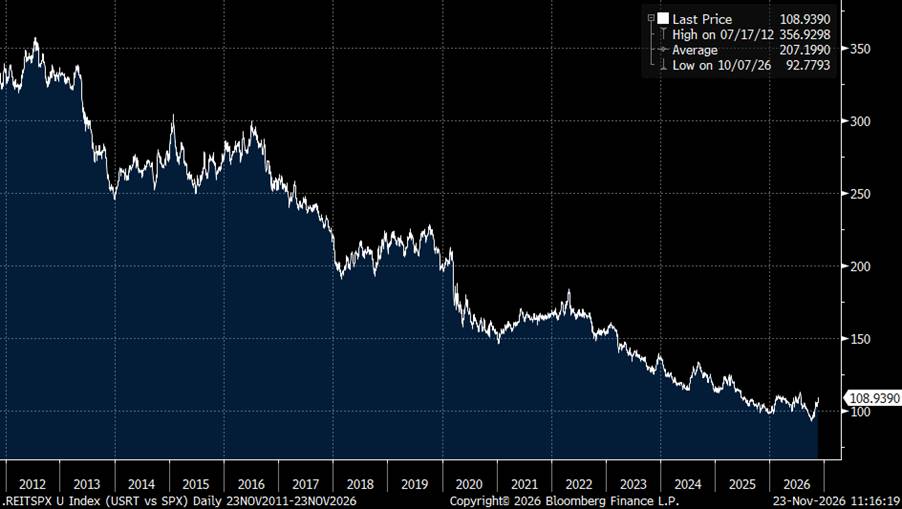
Index rebased to Feb 2026 = 100
Why it fits
Long-term nominal GDP tracker
Real estate is one of the most reliable trackers of nominal GDP for obvious reasons. It’s a finite resource which is crucial for all economic and social existence and is priced according to the ability of people and firms to pay for it.
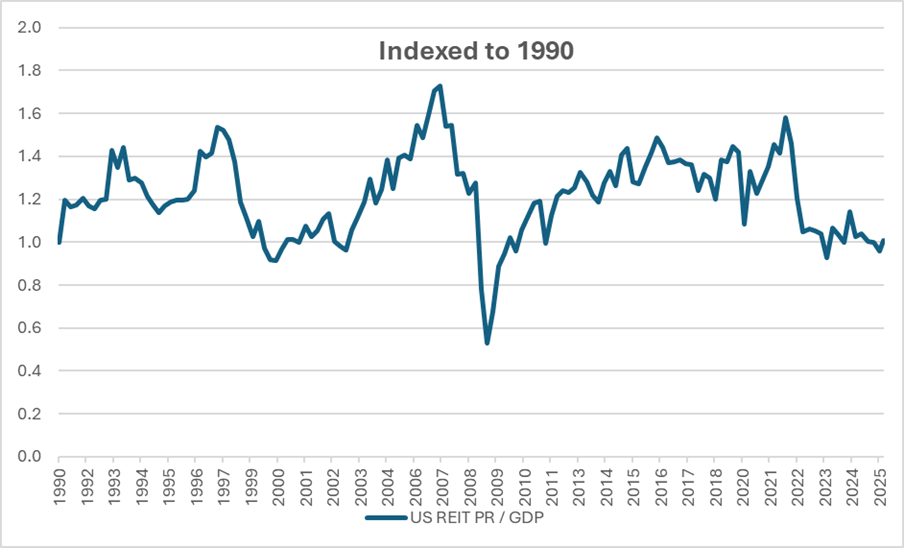
The chart below shows the price of REITS as ratio to of GDP since 1990 broadly tracks with cycles. The boom and then bust from the Great Financial Crisis of 2008 are clear. Since then the market recovered and over the last decade has had a slightly disappointing performance. Partly due to it being unfashionable but also by being hit over the past years with the double hit of the pandemic and the sharp rise in interest rates. My read of the data is that this overhang problem with low occupancy rates is largely over.
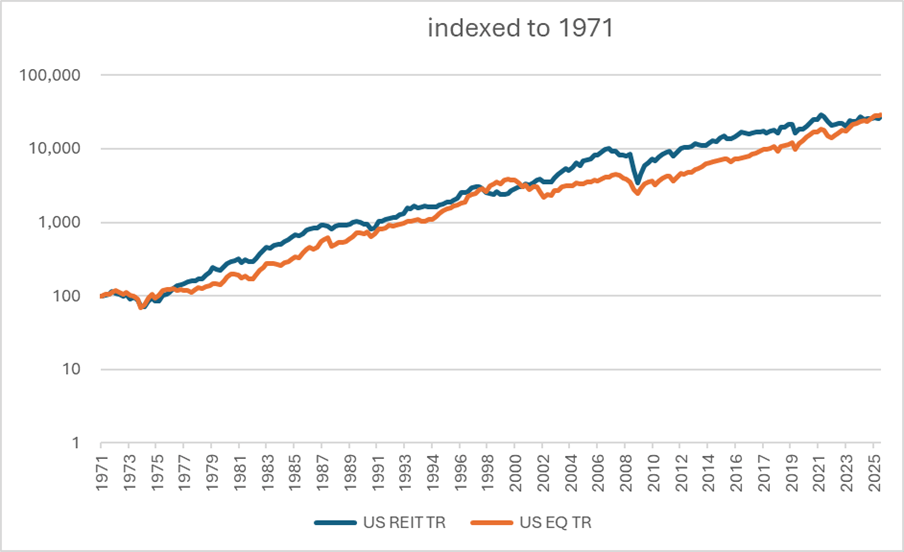
In the very long run equities and REITS are also basically the same thing. The total return chart below may surprise you – as the high yield of REITS is an important part of their long term return. Equities track long term GDP as that is the source of the earnings which are where the value of equity derives.
Unloved versus Equities
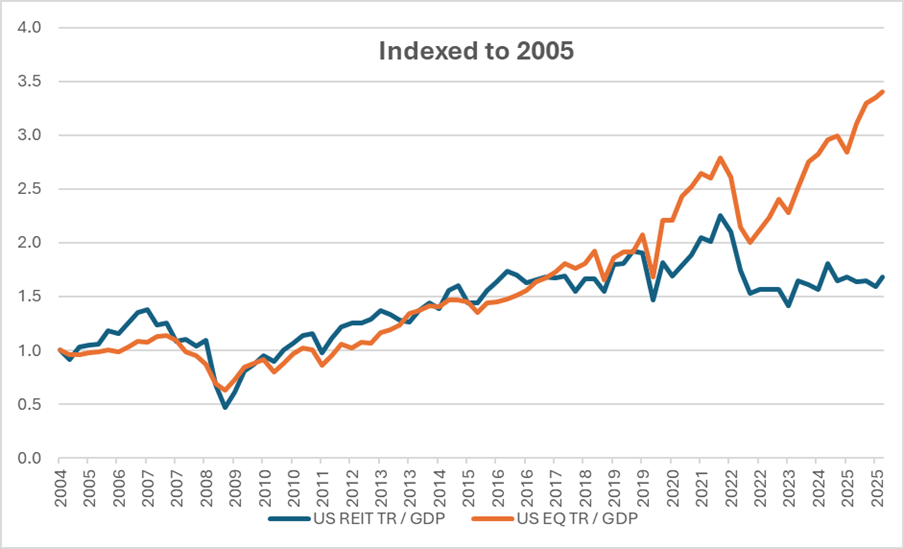
Over shorter periods of 5 to 10 years, these markets can materially diverge, The contrast between the prices of REITS and the S+P over the past decade is striking. The chart below shows a huge divergence.
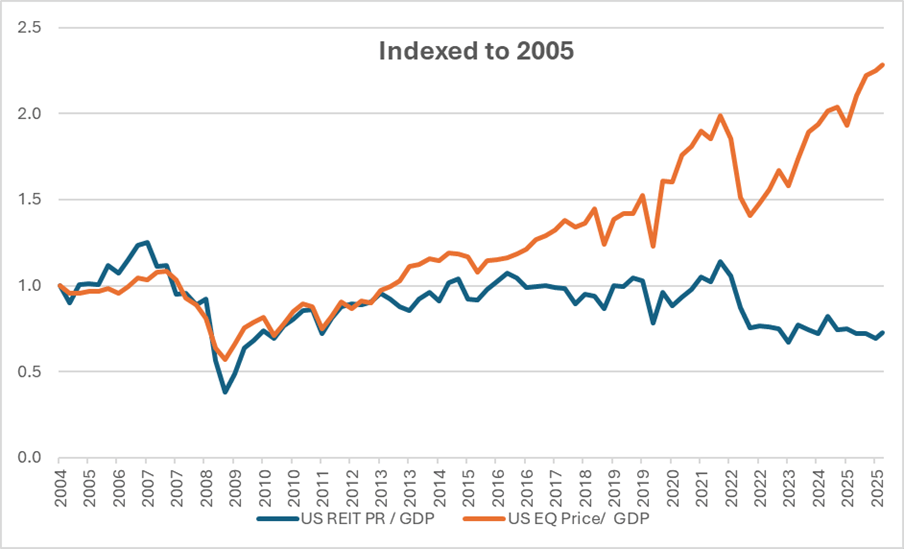
Since the pandemic, the gap in total return with the S&P is more striking, equities have delivered more than double REITS. If there is a bubble in equity markets, REITS have not participated.
We have seen this before in previous cycles
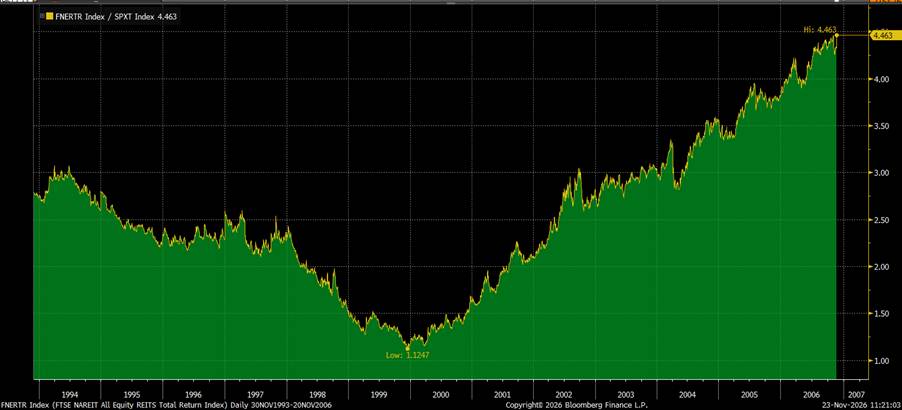
This type of divergence is not unprecedented. During the dot-com bubble equities also soared past REITS with double the return, breaking the previously tight relationship. Then as equities crashed, REITS were far from damaged and in fact they prospered, outperforming for the next 5 years.
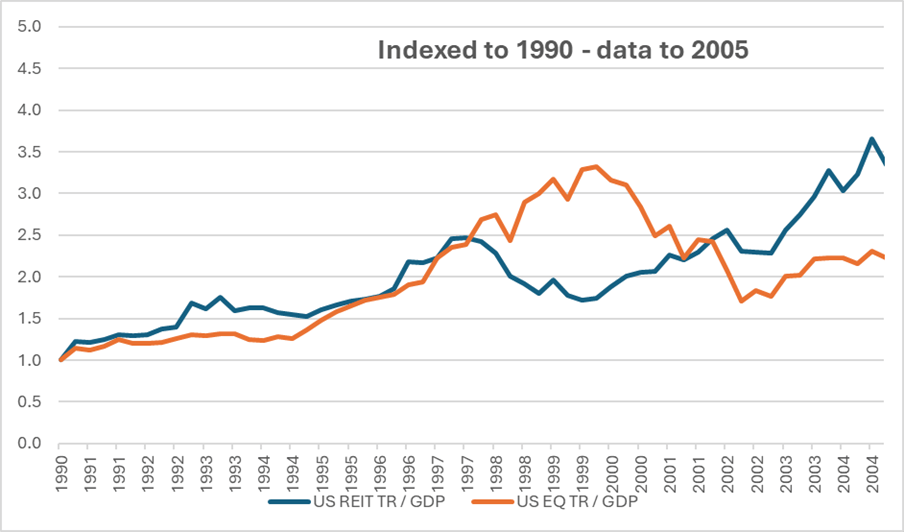
This is even clearer as a ratio. Medium term divergence between REITS and SPX has often been enormous but mean reverting over the long term. If this bubble is anything like the last tech bubble, REITs could be a great investment.
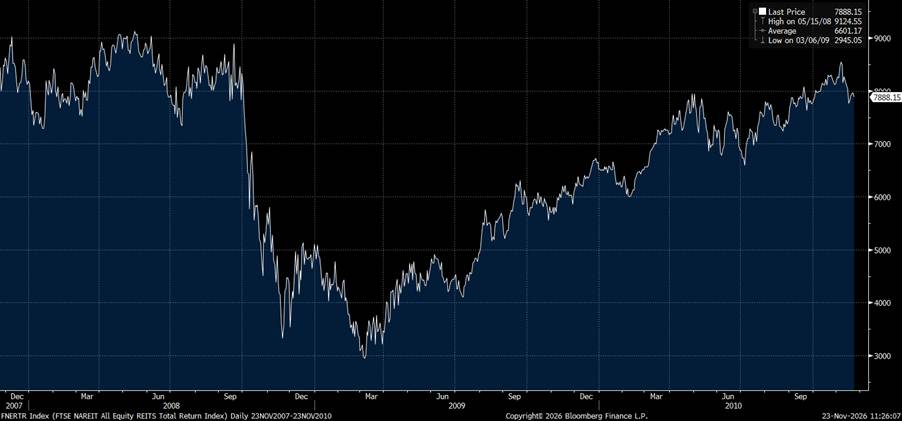
Even though the last bubble was a real estate bubble and in that case REITS started from terrible valuation levels, it is striking how well REITS bounced once rates came down.
What is the ideal environment
Owning tech versus owning REITS is not about whether AI drives productivity and growth. If it does, then both equities and REITS allow investors to participate. The debate is whether current tech companies will capture all the gains. If capitalism works as it should, the benefits of new technology flow thoughout the economy, not just to a small number of monopolists.

