
Why You Can Be An AI Bull And A Market Sceptic
Current stock market prices reflect an extraordinary forecast for the future.
Not just that growth will be strong, but that corporate profits will capture a much larger share of that growth than they do today. Is AI enough to justify that?
Tech firms will make all the money!
This is not a world where future profits are well distributed. The market cap as a share of GDP for non-tech companies has barely risen over the past decade while the tech sector has risen 5-fold. This chart does not even include the $4trn of IPOs of the new AI firms coming this year.
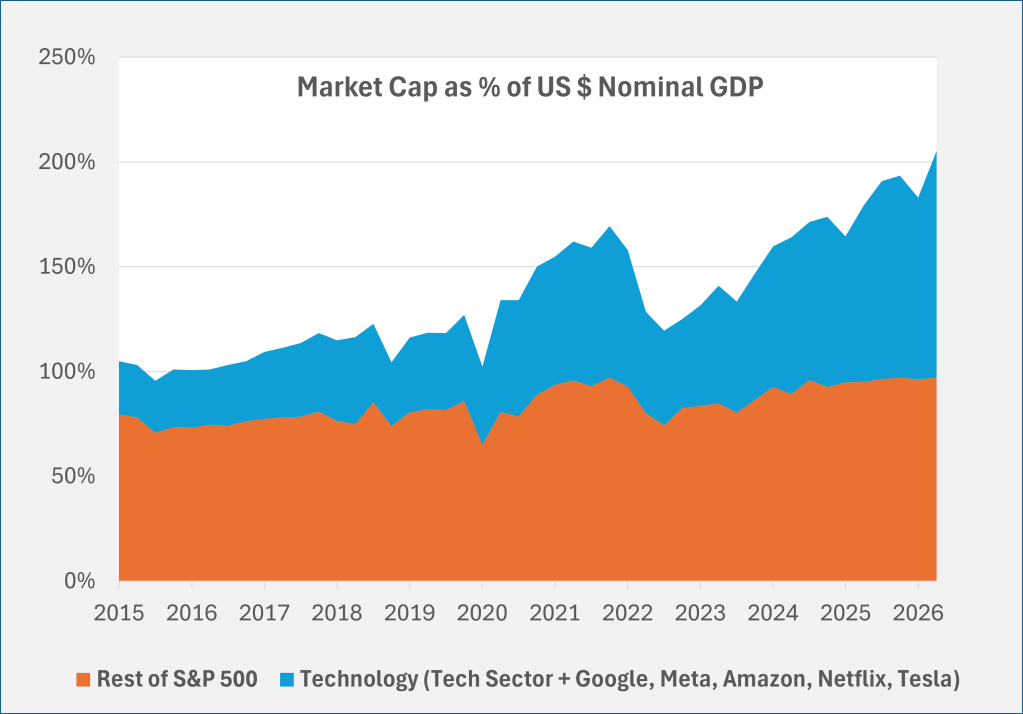
From this, we can see the market is pricing that AI will transform the global economy. Companies in the broader economy will use AI to become much more efficient, maintain revenues while drastically reducing existing costs. However, they are not expected to grow their profits, only tech companies are. The implication is extreme. Cost savings across the economy are almost entirely offset by higher payments to AI providers. The benefit accrues to them, not to the firms using the technology, and not to consumers.
AI valuation framework
For current market valuations to be right, the narrative rests upon three supporting pillars, all of which need to be true simultaneously:
- AI will lead to higher productivity and so higher GDP growth.
- AI will lead to higher profit margins, meaning profits capture an increasingly high share of GDP and gains accrue to firms, not people.
- Today’s tech companies capture those profits, with AI benefiting incumbents rather than new competitors or the users of AI.
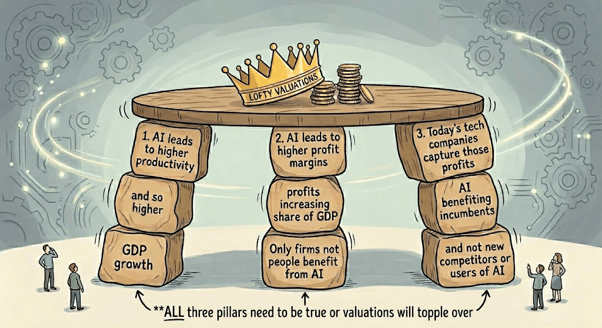
Let’s take these one at a time.
- AI will lead to higher productivity and so higher GDP growth.
My Evaluation: 80% Probability
I place myself as a long-term optimist on this. AI has real potential to be the next major driver of productivity, perhaps on the scale of the internet. We already have good evidence of higher productivity at the individual level (e.g. coders coding faster) but evidence is far weaker at the company level, with little sign of gains showing up in the bottom line.
For me, the key uncertainty is not the direction but the speed. Current market valuations require these gains to show up quickly. History suggests that is unlikely. Previous technological breakthroughs, such as electricity and the internet, took years to work their way through the economy. Companies had to restructure, redesign workflows, and rethink how they operated before the benefits appeared in the data.
We are still at a very early stage of that process with AI.
We do not yet know how much of the economy can be reshaped, how quickly it can happen, or what that transition looks like in practice.
- AI will lead to higher profit margins, meaning profits capture an increasingly high share of GDP and gains accrue to firms, not people.
My Evaluation: 25% Probability
I have far more reservations about this second pillar. In fact, I think the opposite is more likely.
Many observers have the simple view AI will allow companies to cut costs, specifically labour costs, maintain pricing, and therefore profits increase.
This is not how markets typically work.
If a new tool or technology lowers the cost of production, it rarely remains captured by incumbents. Smart entrepreneurs will use it to disrupt the industry, offering the same or better product at a lower cost to gain market share.
The result is lower prices, not just higher margins.
AI is particularly powerful in this respect. It lowers barriers to entry across many industries. A start-up can now develop and launch products far more quickly and cheaply to compete with incumbents. This is an argument for cost reduction, deflation, and the erosion of old, comfortable monopolies.
This process of “creative destruction” is exactly the driver of the productivity increases we described in the first pillar. Economic growth has always been a disruptive process. The faster the growth, the more disruptive.
The creates a tension. The same force that drives growth also undermines existing profits. The greater the growth, the greater the disruption, the greater the risk that the current business profits are challenged.
Politics is a constraint that is often ignored in financial analysis. For profit share to rise materially from already elevated levels, the distribution of economic output would need to shift even further away from labour and towards capital. Maybe trillionaires can continue to bully, bribe, or ignore regulators to build ever-larger monopolies. But if large tech makes another leap toward taking all the economic riches, we are firmly in a post-democratic world where power resides entirely with oligarchs. A world of weaker competition and greater political tension. Historically, these societies are never stable. They have also never been places of high growth, because the creative destruction of economic development is the enemy of maintaining economic rent.
- Today’s tech companies capture those profits, with AI benefiting incumbents rather than new competitors or the users of AI.
My Evaluation: 10% Probability
Using the example of the dot-com bubble, I would argue that Pillars 1 and 2 were both correct. The internet did lead to higher growth, and the nature of tech allowed large monopolies to maintain extremely high profit margins.
Looking back at 1999, profits did not flow to the highly priced equities of the time. Infrastructure firms that brought us the physical internet were seen as obvious winners, but they did not deliver long-term returns. The firms that used the internet a decade later became the ones that captured those extraordinary profits.
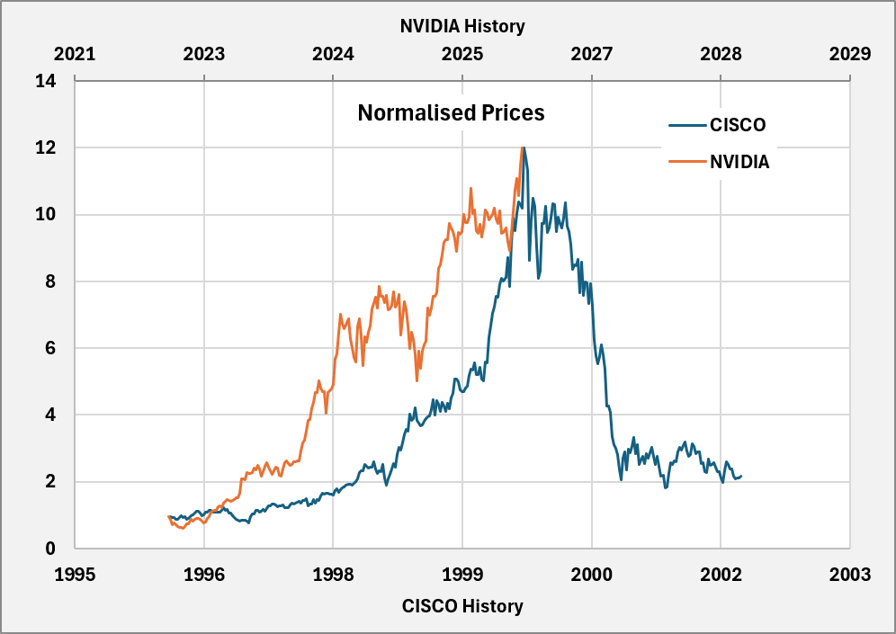
If today’s success stories like Nvidia feel unprecedented, it is worth comparing them with Cisco in the late 1990s. Both critical hardware providers to their respective revolutions – both share prices increased twelve-fold over a matter of several years.
At its peak in 2000, CISCO was the most valuable company in the world, positioned at the centre of the technological shift. The underlying thesis was broadly correct. Internet traffic exploded and the technology changed the economy.
But the investment outcome for Cisco was very different. Margins collapsed as capacity was overbuilt and competition intensified. The long-term profits accrued elsewhere, often to companies that did not yet exist.
The Combined Probabilities: The 2% Reality
Even if we consider these pillars plausible individually, the market requires all three. Assigning rough probabilities and treating these pillars as independent, we can observe how the market confuses a highly likely technological trend for a much less likely profitable investment outcome:
Combined Probability = 0.80 * 0.25 * 0.10 = 0.02
A combined probability of 2% means it is a 50-to-1 shot to justify current market pricing.
You do not have to be a sceptic of AI to be a sceptic of market pricing.
You can be a long term bull on the technology while simultaneously recognizing that buying the current market narrative is a disaster.

