
Why long‑term investors might ignore bubbles
What is a bubble?
We began this series by asking if today’s market is in a bubble. To answer that, we must define the term. For me, a bubble is simply any situation where an asset’s price significantly exceeds any reasonable estimate of its underlying value.
An important distinction is how confident we are in that underlying valuation. The less certainty there is about the true value, the easier it is for prices to drift into bubbles.
Fine art, tulips and the South Sea Bubble all lacked a reliable way to determine value and, with no anchor, prices become arbitrary, with sentiment around what you think other people would pay for it being the only foundation. Similarly for Crypto, any non-zero price has essentially the same objective valuation foundation. No matter how high the price is, it could just as easily be double, so calling it a bubble doesn’t mean the rally is over. In these cases, a bubble is perhaps identifiable when buyers’ primary justification is they will later be able to sell it at a higher price to someone else.
In contrast, assets like government bonds have fixed cashflows so there is more certainty on valuation. The scope for a bubble is therefore smaller as it’s harder to believe you’ll find a buyer willing to pay a premium for a known stream of future payments.
Equities sit somewhere in the middle. They have a real economic anchor, earnings, but these must be forecast years into the future. Understanding this uncertainty is crucial to determine if we are in a bubble and what the limits of it may be. This is what this series is looking to cover.
Earnings – the basis for equity value
When you own equity, you own a claim for a “share” of future earnings. Sentiment and fashion can move prices in the short term, but over time a company’s ability to generate earnings is the only thing that matters.
At the individual company level, analysts spend enormous effort forecasting revenues, margins and competitive moats. The index level is different in an important way. You own everything, the winners and the losers. If Amazon does an amazing job growing earnings, much of that success comes at the expense of other companies, such as retailers, whose earnings decline. This matters enormously for single stock investors, but the index level sees both sides.
What matters for the index is aggregate earnings from the whole economy that produces them, and this comes directly from nominal GDP.
Nominal GDP – the basis for index level earnings
This relationship is wholly grounded in the construction of GDP itself. Corporate Profits, the earnings you own when you buy equities, are one of the component parts of GDP alongside wages, rents and interest as shown in the BEA table below.
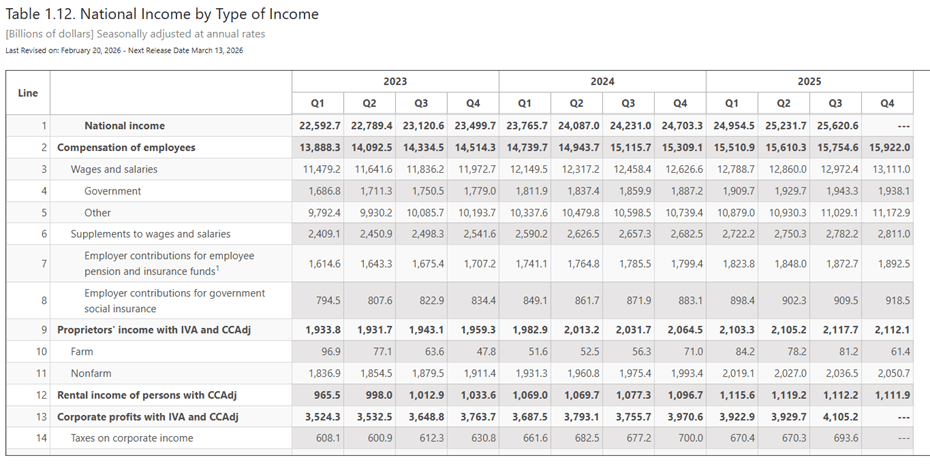
When the economy grows, corporate profits typically grow, and when profits grow, equity prices follow. Not because of market sentiment or fashion, but because equities represent a claim on those profits. This is the fundamental reason buy‑and‑hold works over long horizons.
Profits v Earnings distinction
Eagle-eyed readers may have spotted that I have been a bit loose with my language. I have moved between talking about just S&P earnings and the economy-wide US corporate profits. The chart below shows we can do this as they have tracked each other consistently for many decades.
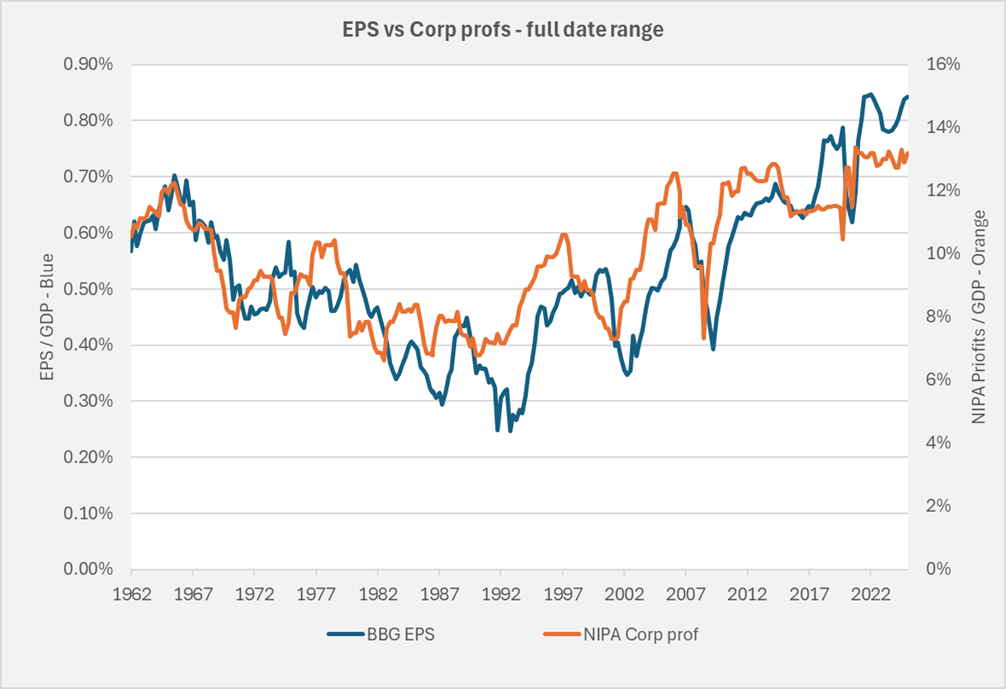
Another question is how can this be true? We know that US firms make huge profits from markets outside the US so surely S&P earnings should outpace the domestic economy. This is completely true, except that foreign companies also make large profits in the US and these effects basically offset.
As a result, we can safely talk about national profits and S&P earnings following the same long-term trajectory.
Fundamental Result
Over decades, the value of the stock market and the size of the economy move together with striking consistency. Equities ultimately track the growth of corporate earnings which grow with the general economy.
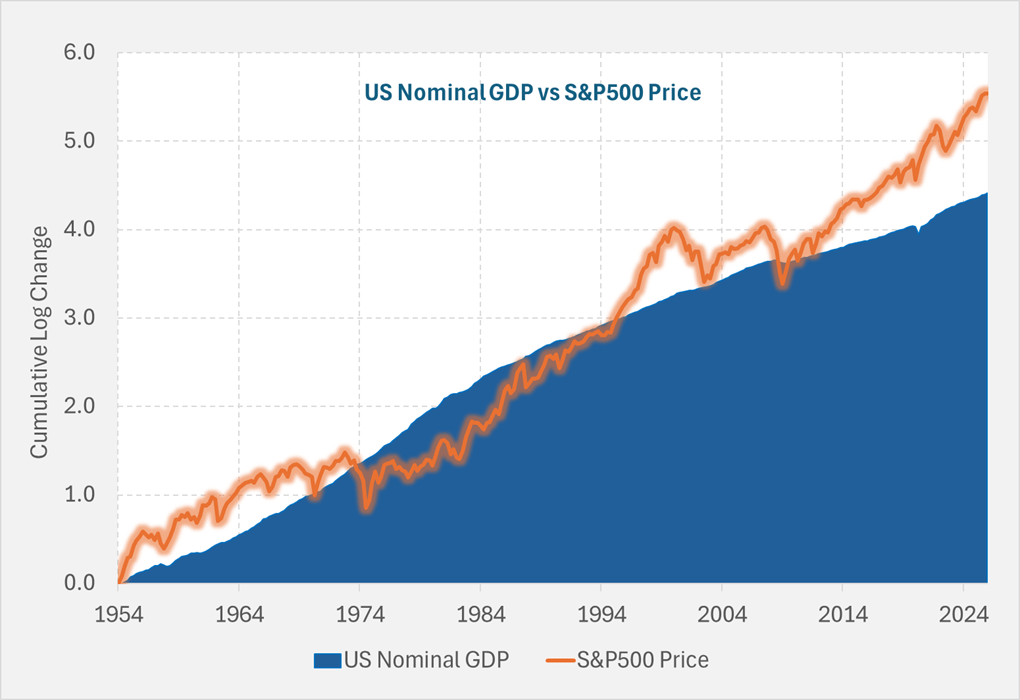
Sentiment can cause the market to move around this anchor, but this chart shows the long-term driver is Nominal GDP. Following Warren Buffett’s advice to ignore the short-term whims of “Mr. Market,” long-term investors simply benefit from compound returns derived directly from economic growth. This is why “buy and hold” works.
As we will see next, although nominal GDP drives equity prices over the long run, the deviations can be large enough that the possibility of a bubble has to be taken seriously.

