
It is time to move from thoughts on valuation to what it could mean for future equity returns.
Valuation tells us little about where markets go next. Overvalued markets can remain overvalued for years. While high valuations increase risk, they are not necessarily a catalyst for correction nor a useful timing tool. Over the long run, however, markets are pulled back towards fair value and there are multiple paths through which that adjustment can occur.
The paths back to fair value
1. Earnings as a share of GDP doubles
As in previous post, one possibility is that corporate profits claim a much larger share of total economic output.
This would have profound social and political consequences for society. Wages would fall for most people and inequality would rise sharply. It would represent a radical test of the modern capitalist system.
I see this as one of the less likely outcomes
2. A massive market correction – a 50% fall in prices
In this scenario, PE ratio and overvaluation reduces, prices fall sharply and expected future earnings reset to a more normal path.
Corrections of this magnitude are rare, but as we have shown the current level of market valuation is even rarer.
There are only three comparable post-war examples are shown below.
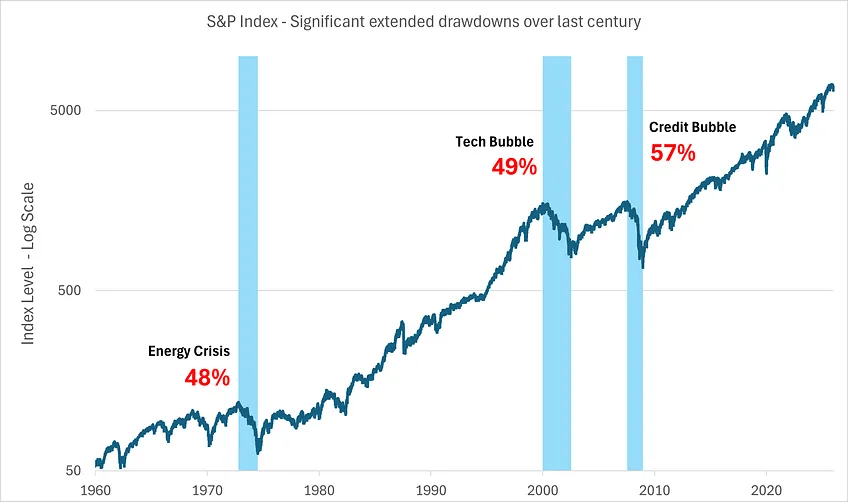
- 1973 – a global economic crisis triggered by a Middle East driven energy shock
Ring any bells?
- 2000 – huge optimism around revolutionary new technology that was transformative, but not enough to justify the market expectations
Ring any bells?
- 2008 – massive expansion of leveraged, opaque credit products that were not properly marked to market
Ring any bells?
3. Equity prices stagnate while nominal GDP rises
Suppose nominal GDP accelerates to 7% per year, an optimistic but perhaps reasonable forecast if productivity gains from AI materialise. Nominal GDP would then roughly double in the next 10 years.
If equity prices then stagnated over that period, with earnings as a share of GDP similarly remaining at today’s elevated level, the PE ratio could adjust to long-term average levels.
As an investor, this is a poor outcome. You break even on a nominal basis while the rising GDP restores the market to fair value. Almost any other return generating asset would have outperformed equities.
The current high valuation of equities did not mean you had a crash, they just implied that your expected return was very low.
4. Some combination of the above
If this all seems a ridiculously pessimistic set of scenarios, I would suggest you have not looked hard enough at the history of stock markets. In practice, the adjustment is likely to involve elements of all three scenarios mentioned above: volatility, drawdowns, and long periods of frustration.
Even in the US stock market, a clear winner in the post war period, has experienced long periods of poor returns even relatively recently
- In 1972 the S&P closed at 118 …..
In August 1982 the S&P was still at 118
A decade of no price progress
- In March 2000 S&P peaked at 1552It returned to that level on 10th April 2013 Again more than a decade later
In both cases, earnings grew strongly.
Between 2000 and 2013 earnings more than double.
The problem was not economic stagnation, it was that the expectations built into the price were far too extreme.
I think this is the current situation.
But…. what if this time really is different?
Could AI mean that the future will look nothing like the past?
Current market prices reflect an extraordinary forecast for our future.
Rapid growth and a dramatic shift in capital capturing a dramatically larger share of economic output.
Could AI be the extraordinary explanation?
I will explore that possibility next.

