Framework for Equity Valuation Part II – Equity Drivers

In previous posts, I have written up ideas on primary drivers and first approximations for fixed income and foreign exchange markets, and I now want to continue with equity markets (Click here for Framework for valuing equities Part 1). This is a little more complex to explain so will take a few posts to go through the steps.

Most equity analysis I read starts from the bottom up. The analyst knows a lot about individual companies or sectors and will extrapolate from there to the broader index. Or if some macro analysis is performed, it assumes some form of “conventional wisdom” such as high growth means higher equities.

I want to start with a top-down equity valuation and so I find a useful way to begin is to break the equity price into components. Then I can compare equities to GDP and the economy, things that I am familiar with already.

This framework can be applied to all equity markets but will start here with the US and the S+P 500.

Breakdown of the Equity Price

Using some very simple algebra:

Price = (Price / Earnings) * Earnings

Price = (Price / Earnings) * (Earnings / Nominal GDP) * Nominal GDP


Focus on the Components

Eventually, I will I look at how these variables relate to each other, but first let’s start examining each in turn:

  1. Nominal GDP Long Term Diver
  2. Earnings Medium Term Driver
  3. PE Ratio Medium and Short Term Driver
  1. Nominal GDP 

In the long-run, Nominal GDP is the only thing that matters for equity prices.
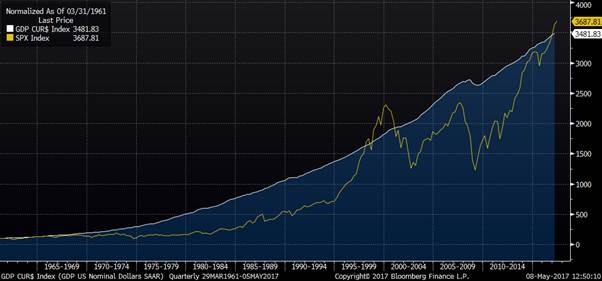
Nominal GDP is 35 times bigger than it was in 1961 and the S+P Index price is 37 times higher. Fundamentally, if you are a long-term investor and just stay long equities, then the rising tide of growth will lift you to large compounded returns over the decades.

However, if your horizon is less than decades, nominal GDP is not such a clear driver of equity returns. In the very short run and even in the medium term of say 2 years, nominal GDP moves far less than equity prices do.

Follow-up Question “Does outlook for nominal GDP matter now for investment decisions?”

See later post

  1. Earnings as a share of GDP

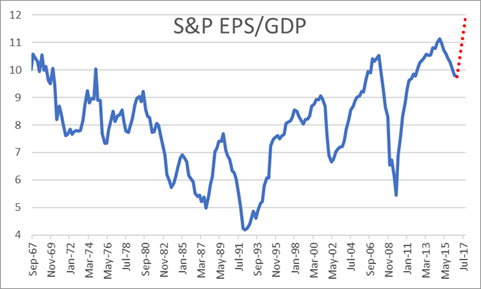
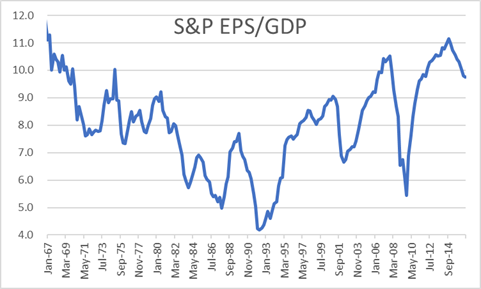
Below is the chart from 1967 to now. Over a given 2-year horizon, we have seen material movements in S&P trailing EPS over GDP. Many are interesting, but the recent financial crisis moves stand out the most. Earnings were clearly volatile but amid the talk of bubbles, panic, and recovery of confidence, how important were they versus other drivers?


Example – Financial Crisis and recovery

During financial crisis earnings dominated.
For all the talk of animal spirits and how equity markets were highly erratic and emotional, the “boring” fundamentals of corporate earnings explained practically all price movements.

Follow-up Question “Outlook for earnings?”

See later post

  1. PE Ratio – Medium and Short term driver

Short term

In the short-run by definition PE ratio is the only thing that matters.
GDP data and earnings releases are only quarterly and so, for most days, the only thing that could have changed is the PE ratio.

You may argue that these daily changes in PE ratio are explainable and even predictable as they are driven by

i) Change in expectations of earnings

ii) Change in expectations of nominal GDP

iii) Change in yields in other substitutable markets

iv) Change in yield demanded from equities due to change in risk preferences or change in perception of risk

Radio and TV programmes are filled with a succession of strategists and pundits all required to “explain” yesterday’s market movement and these factors are therefore reached for repeatedly.

Unfortunately, these short-term changes are all too easy to explain away, given the limited range of explanations that are permitted. But you can tell that these “explanations” are also very hard to predict. The driver that is sometimes assumed is that the PE ratio change is due to rational updating of forecasts of GDP growth and corporate earnings. But markets are too volatile and erratic for that explanation to be compelling and talking about animal spirits is more natural.

Medium term

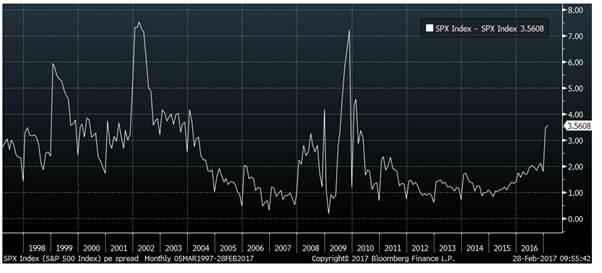
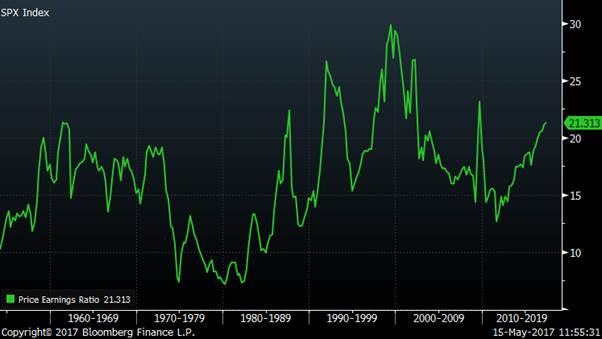
From the chart below you can see that the PE ratio is broadly unchanged over the past 50 years i.e. it is not at all a long-term driver of equities. But it is also clear that with a range of 7 to 30 it can have a huge impact on medium term price movements.


Example – 1980s

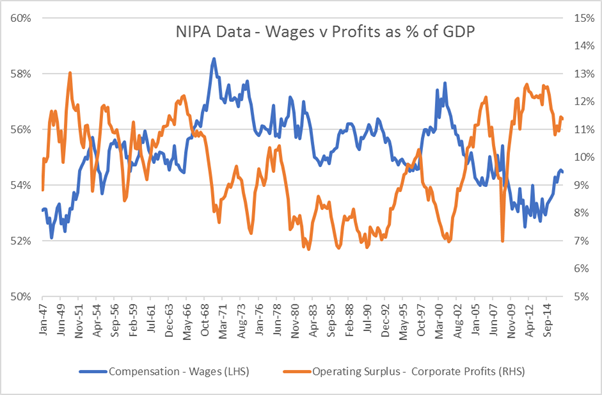
In the 1980s, for all the talk of the transformation of the US economy through the Reagan/Volker years combined with the “Greed is Good” era unlocking corporate value through increased efficiency, it was neither high GDP growth nor rising earnings that dominated the dramatic rise in equity prices. In fact, earnings as a share of GDP fell during this period and it was the rise in the PE ratio that drove prices higher.

One can think of this as a yield effect from the fall in inflation and the subsequent drop in bond yields. Lower bond yields drove yields lower in all asset classes, including property and equities. Lower yields mean higher prices and so we saw a huge bull market, commonly mis-explained by deregulation and improved business management.

Example – 2013 to now


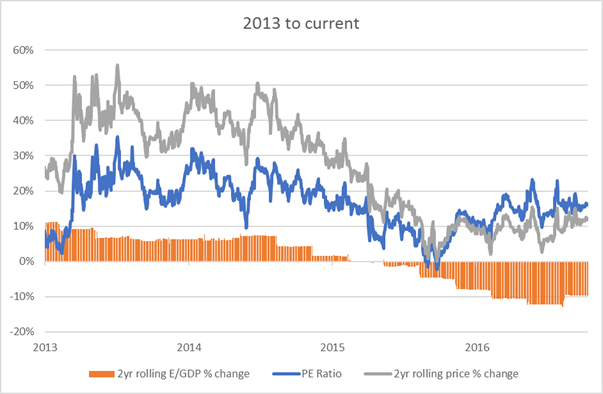
Over the past 4 years, the dominant driver has again been the PE ratio. Despite more confidence in the recovering economy, earnings as a share of GDP has not risen.

Again there has been a the yield effect with QE reducing yields in the bond market (https://appliedmacro.com/2017/05/23/framework-for-valuing-fixed-income-long-end/) and this has slowly filtered into other asset classes, such as equities, reducing yields and increasing prices.


Follow-up Question “Outlook for PE ratio?”

See later post

Conclusion

The framework of separating nominal GDP, earnings and PE ratio is helpful in describing what have been the historic drivers of equity markets. What we can do next is look at the current outlook for each of these drivers and from that the outlook for US equity markets.

Framework for FX valuation – where is the USD heading?

Here is a metaphor to explain how to approach a situation when there are conflicting potential drivers of an asset.

You are sitting on a small yacht, drifting in the sea. You want to know in which direction you will drift: onto those scary rocks or safely away from them. There are two potential factors which could be very important – the wind and the tide. The wind is the one you will be most aware of; but the tide could perhaps be very important even though it is less clear what it is doing.

If you ask for help you may find advice split into 2 camps. Those who believe that the wind is always the critical factor and those who believe that the tide is always the critical factor. This ideological split is not very helpful because there is no consistent answer to this problem. Sometimes the wind will matter more, sometimes the tide will matter more. You have to use your knowledge and judgement to decide how to incorporate those factors.

As for asset markets, this is a useful metaphor for many macro markets from fixed income, to equities to foreign exchange. A clear and important example of this today is how to position ourselves in the USD.

FX Model

Tide – Value (proxy is the real effective exchange rate)

Wind – Relative monetary policy.

Monetary Policy (Wind)

Most FX strategy I have read over the past few months has been bullish the USD. The most common argument relates to divergence of monetary policy. The Fed is raising rates when few other countries are, and with Trump these expectations became even stronger.

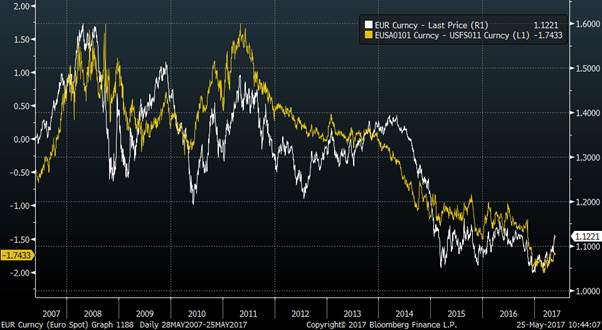
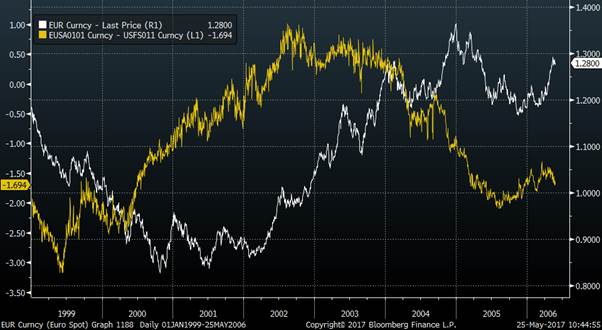
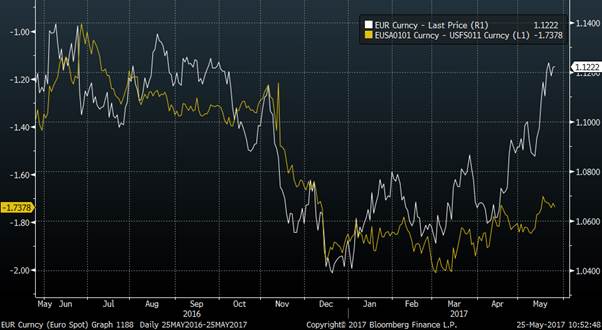
The relationship between the movement of a currency and the relative interest rates in those countries is a good one. If we look at the last decade of the Euro vs the US dollar then we see what a great first approximation it is.

But in financial markets, it is often a mistake to assume that something you have found that works well for a period is always reliable. It is not possible to treat macroeconomics or investing as having “Laws” in this sense.

If we look at the prior decade for the Euro, then the monetary policy model is terrible.

Value (Tide)

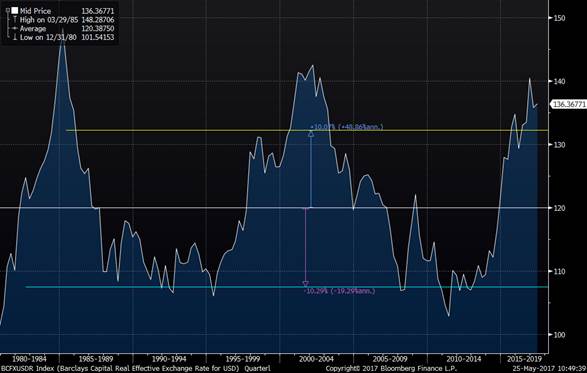
The other first approximation model I want to look is value. For this post, I will take the real effective exchange rate (REER) as a simple proxy.

It is clear from this chart that assuming a mean-reverting tendency in the REER would not have been at all useful in the past 3 years. The USD has been above its average value and heading higher strongly.

Maybe value only matters at extremes? Taking a longer view, adding bands of +/- 10% gives us a sense of how far the USD can move before a value constraint starts to be meaningful.

If you take the model for the yacht as the same conditions last time you went sailing, when there was not much tide and the wind blew you safely away from the rocks, this is not sensible. It would be particularly dangerous if there is a rip tide and you are ignoring it by assuming that a light breeze will determine your path.

Why is everyone talking bullishly about the USD?

  • Recently value has been a terrible model.
    The US dollar is expensive and going higher
  • Rates differential has been a great model
  • Simple extrapolation means that people believe rates will continue to be the best model in the future

Signs this may be happening now

The recent strengthening of the euro is often “explained” with reference to a potential change in QE from the ECB. But rates have not moved. So perhaps we are seeing the influence of a force we have not had to pay attention to recently. Value.

Conclusion

Macro investing is hard. The world is complex and confusing.  Over the years I have noticed many people fall into one of two traps

  1. Become fixed in a single view of how the world works and happily ignore or rationalise away contrary information
  2. Form a fluid view of the world which adapts to a model which can make the most sense of their recent experience.

The time we can make the most money from markets is when they are the most wrong. This can happen people are using the wrong model.

Framework for valuing fixed income – Long end

I do a very different analysis of the long-end of the yield curve, compared to the front-end. (Framework for valuing fixed income – Front end) Mathematically, you could take the same approach and bootstrap the curve from a complete set of forecasts of short-term rates for the next 30 years. But this seems a bit silly and begs the question of how you would get these forecasts anyway.
To simplify the analysis, what we have to work out is what the long-term “equilibrium” rate will be and ignore for now how we get there or use the analysis from the front end to build a path.

Simple Hypothesis: Long-Term rates = Nominal GDP

An approach that appeals to me is to look for a link between long term interest rates and long term nominal GDP. I think of it as a “Wicksellian” natural rate which the market will tend to revert to i.e. If interest rates are consistently far away from the growth rate of nominal GDP then there would be a persistent drag or stimulus to growth which would not be sustainable. You can get to a similar idea from several different economic frameworks.

If we look at the data then, the hypothesis looks reasonable. Below is the 10-year average of nominal GDP growth alongside the 10y10y interest rate for the US. The 10y10y rate is the rate you can calculate as what the market implies the 10y interest rate to be in 10 years’ time.

Before the early 2000s, interest rates were consistently a little higher than GDP. Academics were happy with this and explained it in terms of some type of premium which bond owners would demand to own bonds. They were then confused in the early 2000s by the “conundrum” that long term yields dipped, explaining it either by Chinese ownership of Treasuries or a global “savings glut” which was forcing down yields.

Outlook for Nominal GDP

Current yields do not look very remarkable to me, but they are only correct if you think that nominal GDP will remain as low as for the past decade. The most prominent argument that we should expect this to continue comes from Larry Summers and his promotion of the idea of “Secular Stagnation” – http://larrysummers.com/2016/02/17/the-age-of-secular-stagnation/

I find these arguments a little hard to engage with as we must recognise how utterly useless long-term forecasts of anything generally are. I should admit that I am not a big fan of anything which looks like a restatement of the savings glut theory to me, but I do not want to engage here in an academic debate. As a more practical question, I think that the burden of proof is on ideas such as Secular Stagnation and the “New Normal” that the world will need permanently far lower rates than it has in the past. Arguing that nominal GDP will be lower, due to slower population growth, demographics and potentially lower productivity is easy. Explaining why it is 3% lower is not so easy.

My view is that this economic cycle does not require new theories to explain it. A financial crisis results in a very deep recession and leaves scars which mean the recovery is slower than many expect. These hangovers from the financial crisis are what Yellen refers to as “headwinds” which are slowing down the economy. Risk aversion among consumers and businesses after such a bad recession is only to be expected and the impairment of the credit channel after such a disruption is also understandable. But there is no reason to think that these headwinds are permanent. They can abate and we can return to a world similar to the one before, both in terms of the level of nominal GDP and also the relationship between interest rates and growth. The financial crisis has been traumatic, especially for countries like the US and the UK, that have not seen one like this recently. However, the history of financial crises is that they are worse than people think, but they are not permanent.

Are we renormalizing?

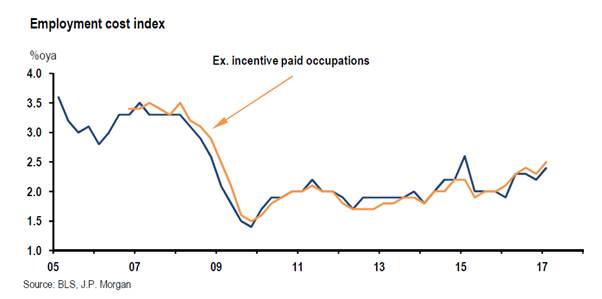
Unemployment fell slowly but is now down to 4.5%. wages have been sluggish but are now picking up.

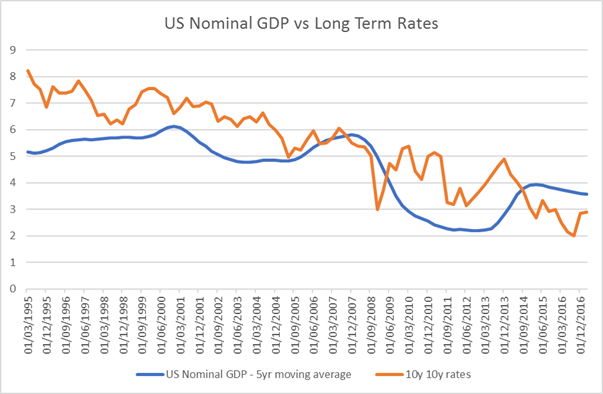
If I draw the first chart again but this time use a 5yr rather than 10yr moving average then perhaps I can argue the market is reacting too slowly. Nominal GDP has been rising recently and with rising wages and inflation can easily be seen to be likely to continue to do so. If that is true then market rates are too low.

Why are long term rates still so low?

The idea that long term rates are too low is hardly new. After all this was the whole point of QE!! The central banks buy huge amounts of long term debt to drive up bond prices and yields down. This helps to stimulate the economy and boost other asset classes which look relatively cheaper to bond markets, and so drives reallocation flows.

As I mentioned in this post (https://appliedmacro.com/2017/05/01/government-debt-framework-uk-follow-up/), we are living in a new era of financial repression. Therefore, I really do not need any grand theory from the supply side of the economy to explain low rates. I just look at the huge boost in demand for bonds from the central banks.

Is there a catalyst for change?

  1. One potential catalyst would be from the front end. If the Fed hikes rates faster than the market expects, then this can cause a shock to ripple down the whole curve. We saw an extreme version of this in 1994.
  2. If wages start to accelerate then the Fed, economists and market participants would have to radically reassess their assumptions about the inflation outlook and the appropriate level of rates. If you are very confident this cannot happen, you have more faith in our understanding of this type of macro variable than I have.
  3. Even without any fundamental driver we may see a repricing simply from a change in the supply and demand dynamics of the bond market.

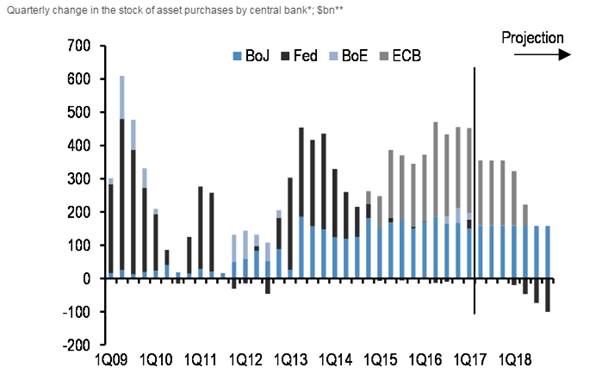
QE buying has been high for the past few years but it is finally slowing down. This may be the catalyst for a repricing of bonds.

Conclusion

A simple and yet historically useful framework for considering long term rates is to use nominal GDP. In recent years, we have seen the combination of a major downshift in long term expectations for both nominal GDP and the level of rates relative to nominal GDP. While many arguments justifying this change as permanent have some merit, I think that they are more temporary then current market pricing implies. Which means that I do not think that bond markets are cheap. In fact, I think they are wildly expensive.


Framework for valuing fixed income – Front end

In a previous post, we looked at a model of relative value of equities versus bonds (https://appliedmacro.com/2017/05/09/are-equities-expensive-part-i/).
But it does beg the question of whether bonds are good value themselves.

I am not aiming for a full review of global bond value, I will focus purely on the US market. In this post, I shall look at the front end of the curve and in a later post the long end.

Expectations

The simplest and best model for the short end of the yield curve is the expectations hypothesis.
The yield is an average of short-term interest rates that are expected to prevail through the life of the security


Such expectations may not match the market yield, so there may be a residual. This residual r is sometimes called the premium (choose any: risk premium, term premium, liquidity premium, it does not matter which). At times such as during the financial crisis, I spent a long time modelling precisely the premia, but in normal market conditions it’s not very productive. Merely knowing if the premium is large or small, positive or negative is sufficient.

The other term often used for premium is expected return. If you think in terms of academic “efficient market” models or asset allocation in a real money environment, then you may prefer to use excess return but the language does not matter here.

US Front End

In the US, the Federal Reserve effectively sets short term interest rates, the Fed Funds rate, and these days they helpfully publish quarterly forecasts of where the committee thinks it will be. A sensible starting point is to compare these forecasts to the tradable yield and calculate the residual.


If you have not been following fixed income markets for the last few years or have learnt how markets work from finance textbooks, you may find this chart surprising.
We, as market participants, are well used to the fact that the market is pricing that rates will be significantly lower than the people who set them expect them to be. This has been the case for a long time but so far, the market has been better at predicting how the Fed will behave than the Fed itself.

If we look at a chart over the past 2 years where rates have been expected to be at the end of 2018, we see some fluctuations but very little net movement. In contrast, the Fed has been consistently revising lower its forecasts of where it thinks rates will be.

If we cannot just assume the Fed know what they will do, we must form our own opinion on where rates might go and determine whether the market is under or over pricing the path. The way to do this is to break down the elements of the forecast and analyse each of them.

The Fed’s reaction function & the Taylor rule

To start with the obvious, the Fed decision can be thought of as a function of things they care about. It is often called their “reaction function” and the things they care about are employment and inflation, their explicit objectives as given to them by Congress.

A common and useful form of this is the Taylor rule, which models Fed behaviour on just two variables.


Using this to make investments

The Taylor Rule is not that useful as a predictor of rates, but it forms a useful framework to think of what drives them.

There are 3 obvious places where you can disagree with the market and so make an investment call.

  1. A different view on growth

One of the largest and most obvious trades in my career was short term rates in 2002. The economy had been very poor in 2001, but the memory of the bubble was perhaps still so vivid that the market priced a rapid rebound in growth and thus interest rates. 2002 did not turn out to be the year of recovery and rate expectations fell accordingly all year.

  1. A different model of the economy

A good example of this would be 2008. Even after Lehman went under in October 2008, it took a long time for people to understand how serious it was and the devastating impact on the broader economy. The market was still pricing that rates would be nearly 3% at the end of 2009. They ended up close to zero. Rates eventually plummet in 2008 because the economy is falling apart.

A counter-example where a commonly believed idea turns out to be wrong is the idea that Quantitative Easing (QE) is going to lead to high inflation and so bonds will collapse. This comes from the idea that inflation is caused by “money” and the Fed is “printing money”. A simple and appealing argument that comes from a misunderstanding of what “money” is and how the monetary and banking system works. (a good topic and controversial later post I am sure).

  1. A different view on reaction function.

An example here would be that after the crisis many people were very premature in thinking that the economy would get back to normal.

In the summer of 2013, rates were still zero and the Taylor Rule suggested that was appropriate. But taking the economic forecasts at the time and projecting what that meant, suggested that rates would be much higher. So back in 2013 the market was pricing that rates would currently be about 3 %. In fact they are around 1%.

This difference is not because the economic growth forecasts were wrong. But the reaction function was. If you listened to Fed Chair Yellen’s speeches she was clear that the Fed would be very “patient” in raising rates. They desperately wanted to avoid hiking prematurely and actually wanted inflation to be higher. So a new reaction function should have been understood – that the Fed were waiting longer to hike to get the economy to be running hotter.

What about now?

My experience of financial markets is that is that expectations are more commonly adaptive than rational. By this I mean that humans (including market participants) tend to overweight recent experience. Given that the Fed has been consistently too high in their forecasts for the last few years, people expect that will continue to be the case. I am not so sure.

I am inclined to use an even simpler new reaction function for the Fed based upon wages. In previous cycles, they would hike before wages rose because

  1. They were confident in the economy
  2. Inflation and wages were high enough already to take a risk if they go lower again
  3. Wages are a lagging indicator, so by the time wages rise the economy will have been running too hot for too long

This time they want wages and inflation to be higher before they even start. The data suggests to me that wage growth is finally recovering.

It is reasonable to think that the economic cycle works the same now as in previous periods, and so wages are a lagging indicator. That means that the labour market has been tight for a while now and is continuing to get getting tighter adding more upward pressure on wages.

Conclusion

This cycle has been very different from prior periods because

  1. The recession was very deep
  2. The recovery was slow
  3. The Fed wanted to wait until they were sure they needed to raise rates.

This has meant that being long the front end has been a reasonable trade for a long time i.e. the front end was cheap against my expectation of where the Fed would set rates. But with the signal that wages are finally rising, we may be approaching the end of this phase. Furthermore, with so little still priced for rate hikes from the Fed the front end does not look good value to me.

If the US recovery has been slow, but the economy not long-term impaired then this means that the rate cycle has been delayed, not that it is not coming or that where rates end up will be so much lower than in previous cycles. But that is the topic for the next post.