Framework for valuing equities Part IV – PE Outlook

In previous post (Framework for Equity Valuation Part II – Equity Drivers), we have seen that the PE ratio can be an important medium term driver of equity prices. Given the debatable outlook for aggregate corporate earnings, this makes the outlook for the PE ratio a critical factor in forming a view on equities.

Simple PE ratio

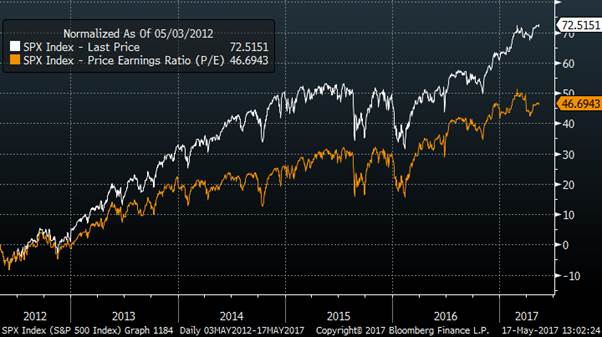
It should be very clear from the normalised chart below that the powerful driver of the equity market performance since 2012 has been an expansion of the PE ratio. The S+P has risen by 72% over that period, and the majority of that is explained by PE ratio which has risen from 14 to over 21, an increase of almost 50%.
Can PE ratios go higher from here?

If we look over the long run, it is very rare for the PE ratio to move higher from where we currently are. In fact, it has only happened 3 times; 1991, 1999 and 2009.
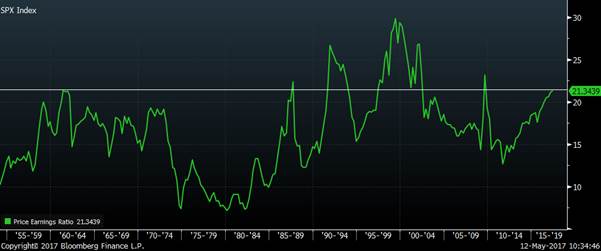
In 2 of these 3 examples, high PE ratios were observed during a recession and ensuing bear market with earnings falling even more than prices . For example, in 2009, the high PE ratio was driven by the collapse in earnings not the soaring of equity prices to record highs. These are not helpful precedents for equity bulls right now.

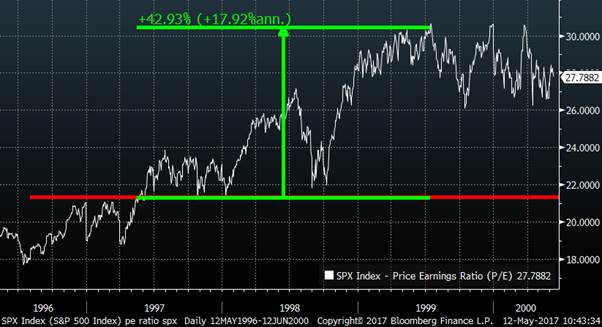
The only previous period where the PE ratio drove the market higher from this level was the dot com bubble. The name given to this period gives a big clue as to what we now think of what happened. If that were to be repeated, then there would be another 40% left in this rally due to PE expansion. This is not impossible but relying on a repeat of the biggest valuation bubble in a century is not reassuring to me.
“Fed Model”

The post I wrote about the Fed model implied that equities represent good value compared with bonds. This generates a counter-argument to my scepticism of a repeat of the dot-com bubble. We have never seen bond yields this low before, so why should we not also see unprecedented low yields in equities (high PE ratio)?

As I explained in my previous post (Framework for valuing equities Part 1- Compared to bonds), I do not think that bonds are good value and so simply beating their performance may not be a high enough benchmark. Most importantly, if QE-driven low yields are pushing up PE ratios, then the termination of QE and rising bond yields should be very harmful for equities.

The other problem is that, even if it is true that holding equities for the next 10 years may work out, the volatility and drawdown you experience may be hard to handle.

For example,
In May 2007 from my equity model (Framework for valuing equities Part 1- Compared to bonds), the expected 10 year return for equities was 8.1% (annualised)

It actually turned out to be 7.1% annualised – which resulted in a total return of almost 100% over 10 years.
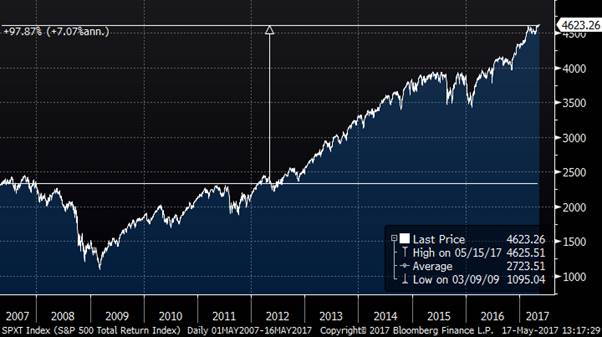
That sounds pretty good.
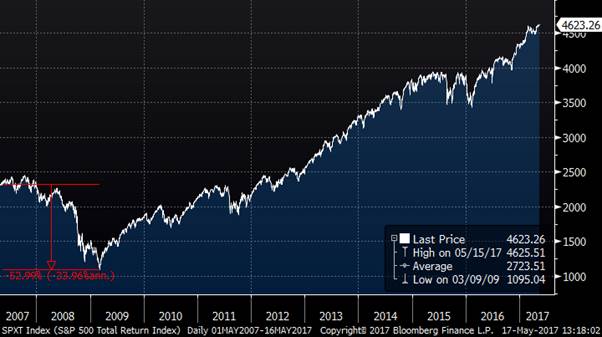
But I bet it would not have felt so good less than 2 years later in March 2009 after a 53% drawdown.
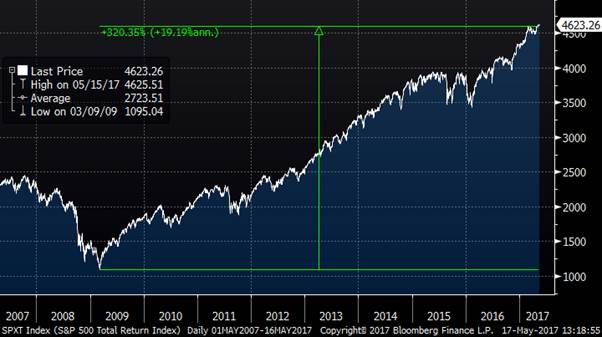
With hindsight waiting for a better moment to enter the long equity trade would have been phenomenally better. If you had waited to buy in March 2009 instead (I know, ludicrous cherry picking, but just about any time around then was great) then your returns would have been a total of over 300%.

Conclusion

The outlook for equities from the perspective of high nominal GDP or high earnings growth look rather limited. Earnings is near record highs as a share of GDP and we are at the stage of the cycle where wages are rising instead.

If we rely on a PE expansion to make us optimistic, we need to be comfortable buying at levels which previously have been associated with a “bubble”.

We can perhaps consider equities being good value compared to bonds, but we must then remember that yields are too low given fundamentals and the termination of QE.

If you are happy to hold them for a decade and do not worry too much about drawdowns, then I come up with an expected annual return of 6.5%. This is higher than bonds right now but perhaps waiting for a better entry level will turn out to be a better strategy.
Framework for Equity Valuation Part III Earnings Outlook

We explored in the last post (Framework for Equity Valuation Part II – Equity Drivers) how earnings as a share of GDP can be an important driver of medium term equity returns.


What is the market expecting earnings to be?

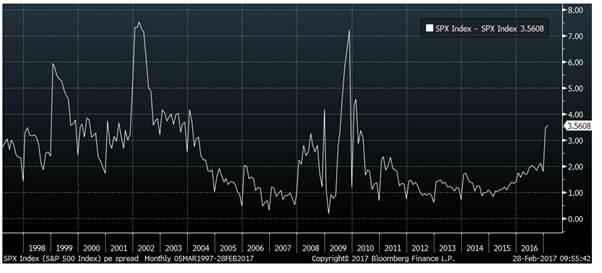
The chart below shows the difference between what the PE ratio is today and what it is expected to be in a year’s time (i.e. a measure of what analysts expect total earnings growth to be). Currently it shows that equity analysts are predicting a 20% increase in corporate profits. This implies that although the current PE ratio may be high, it will be brought down by rapidly rising earnings.

I find this chart is the best explanation of the Trump rally. Analyst earnings expectations rose immediately and this is temporarily reflected in a higher PE ratio. Once the earnings come through we will see that the rise in equities was driven by earnings not by animal spirits. Assuming the analysts’ earnings optimism is correct of course.

What does this mean for earnings over GDP?

I will leave aside for now views on how effective Trump will be at increasing growth and just look at the confidence level implied in market prices. It is all too easy with controversial political figures and issues for analysis to become infected with partisan assumptions and desires which lead to worse decisions.

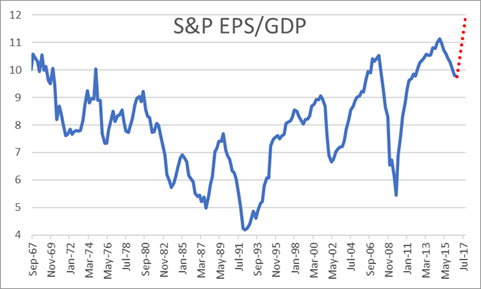
The first point to note is that taking analysts expectations of a 20% earnings increase, this would imply earnings as a share of GDP will immediately rebound to all-time highs (dotted red line in the chart we used previously). We have seen drops in E/GDP of that magnitude before during recessions but never an increase and this seems an odd stage of the cycle to expect it.

Is this forecast consistent with other data?

Another useful way to use national income data is split the economy into just 2 parts – Wages and Profits.

The National Income Accounts (NIPA) data is used a lot more by economists than it is by market participants. To give some context, it was particularly useful to use during the late stages of the dot com bubble, as it showed that reported earnings were far in excess of the profits seen in the national accounts. This implied some form of earnings inflation and potentially even fraud, which actually did come to light later in 2002. The chart below shows how the reported earnings diverged for 4 years before coming back in line very sharply. Checking reported data and forecasts for simple internal consistency can be surprisingly rewarding. It is best not to assume that analysts have done this for you.

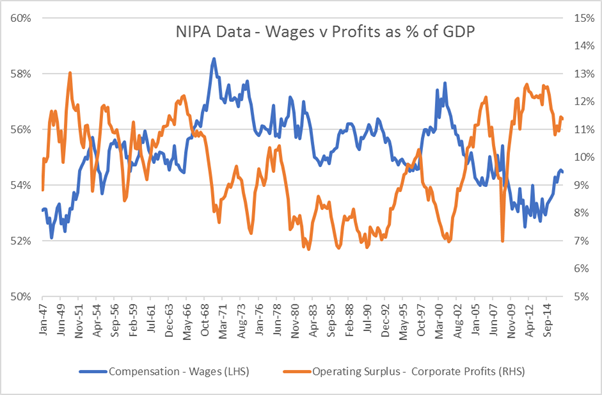
Using the National Income Accounts data, we can construct a chart of the respective shares of national income for wages and profits. As you can see, there is a clear and logical inverse relationship between wages and profits as a share of GDP.

We know that wages have finally been rising again recently and all forecasts are that this will continue. So how can we have nominal GDP of 4%, wages rising at least 2.5% and profits rising 20%.

Quick answer – we can’t.

Long answer – it requires some heroic assumptions in other parts of the national accounts which I won’t go into here.

Scenario – if we assume corporate earnings will rise by 20% over the next 12 months and allow the other components of GDP (including proprietors’ income) to grow at 4%, we can solve for wages and we get an increase of just 0.7%. Rather different from the 2.5% current seen in average hourly earnings.

Summary

There is a great deal of optimism among analysts for the outlook of corporate earnings. It is hard to reconcile that with some basic arithmetic from the national accounts. When nominal GDP growth is moderate and wages are accelerating, it is hard to also get record increases in corporate profits. If earnings do not rise as rapidly as anticipated then to be optimistic on the S+P you need to be positive on the prospects for PE expansion. I will look at that next.

The ethics of climate change

The ethics of climate change raises the most difficult questions.
I am not writing an environment blog, but to get a sense of the difficulty of the philosophical issues, here are some of the big questions:

  1. Intergenerational transfers
    The costs are borne by people alive today for the benefit of people who are not yet born. How do we balance the interests of those two groups?
  1. Democratic Mandates
    Is a country run a by a government with a mandate to look after the current population? Or for the long-term future of “the country”?
  1. Historical Emissions
    Should historic carbon emission be allocated to countries?
    Is the nation state the bearer of historic liabilities from the activity of its deceased former inhabitants? Do new immigrants take on this liability?
  1. Developed versus Developing economies
    How do we balance the desire for developing economies to grow into developed ones and the West’s desire to stay wealthy with a decline in carbon usage?
  1. Is Carbon a right or a consumption good?
    Is carbon usage a consumption good like any other i.e. the rich get more of it
    or is it a human right in which every person on earth has an equal right?

It’s interesting how infrequently these issues get discussed in the public debate, which focuses primarily on the technical models or measurement issues. It is also striking that an issue like Climate Change can so accurately be characterised as partisan issue of political left vs right. That Trump wants to withdraw from the Paris Agreement or that Bernie Sanders supports environmental action is not surprising. This predictable difference cannot be explained away by describing your opponents as crazy, it is more likely to come from a deeper difference of view on the underlying ethical issues.Whenever I hear a climate scientist claiming authority and opining that the science indicates a particular policy path, I feel that they have just not understood how difficult this problem is. They generally have no expertise or authority in anything other than a narrow field and like all of us bring our personal ethical values to the debate. When scientists unknowingly embed their ethical views into their scientific views it makes it far easier for their opponents to criticise the science.

Science is important but philosophy matters too.