How to reduce your Risk Part III

Trick question (click here for the question, and here for the answers)
There is no right answer because risk cannot be minimised.
It can only be transformed from one type into another.


What did people choose?

Option A was the most common answer. For those who trade in financial markets, this may be surprising.

If I reframed the question and asked:

  • Please calculate the DV01 of Options A and B
  • Please calculate the VAR of Options A and B
  • Please tell me which of A or B has greater risk

You would quickly work out that B has zero DV01 and zero VAR. Hence by the definition of risk used on trading floors, A has higher risk. Unsurprisingly asking this question to a room of traders at investment banks, I get the overwhelming answer B because that is the context in which they think about “risk”.

If I ask the question to people who work in property or private equity, then I am more likely to get the answer A as certainty of cashflow is critical, especially when thinking about assets and liabilities. In the accrual accounting world of regular banking, they think about Earnings at Risk (EAR) and Option A is the way to reduce the risk.

The answer given likely relates to your personal circumstances and the exact framing of the question. If I had the time running a series of experiments with slightly different wording, rates or quantities I think would give interesting results.

But for now, the practical lesson is important. People do not instinctively understand risk at all well. We are presented with questionnaires from investment advisors which ask us for our risk preferences with no definition of risk. From the results of typically recommended portfolios, it would suggest that bonds are low risk and equities high risk.

My approach

I think that the best way to think of this question is in terms of a balance sheet. Whether choice A or B “reduces” your risk depends on the extent to which it matches the tenor of your liabilities. If your liability is short term then Option B is the sensible answer. For investment banks, they have no corresponding long-term liability apart from capital. They typically hold wafer-thin amounts of capital against market-to-market assets so naturally recognise A as a risk. For someone who is keenly aware of what they see as fixed longer-term liabilities such as paying school fees or retirement expenses then the choice of a long-term asset i.e. Option A, is far more natural.

Risk matters

Whenever risk gets mentioned, I very rarely observe a discussion of this nature. Often only one side of the balance sheet is being examined and the vastly important implicit assumptions from the liability side are not considered. I am an advocate of multiple forms of risk measurement, including VAR, but only if it is used in the correct context. Many of the worst financial disasters have occurred by taking a risk and accounting concept that was appropriate in one context and transplanting it to another. AIG and Enron are the biggest ones that spring to mind.

Framework for valuing fixed income – Long end

I do a very different analysis of the long-end of the yield curve, compared to the front-end. (Framework for valuing fixed income – Front end) Mathematically, you could take the same approach and bootstrap the curve from a complete set of forecasts of short-term rates for the next 30 years. But this seems a bit silly and begs the question of how you would get these forecasts anyway.
To simplify the analysis, what we have to work out is what the long-term “equilibrium” rate will be and ignore for now how we get there or use the analysis from the front end to build a path.

Simple Hypothesis: Long-Term rates = Nominal GDP

An approach that appeals to me is to look for a link between long term interest rates and long term nominal GDP. I think of it as a “Wicksellian” natural rate which the market will tend to revert to i.e. If interest rates are consistently far away from the growth rate of nominal GDP then there would be a persistent drag or stimulus to growth which would not be sustainable. You can get to a similar idea from several different economic frameworks.

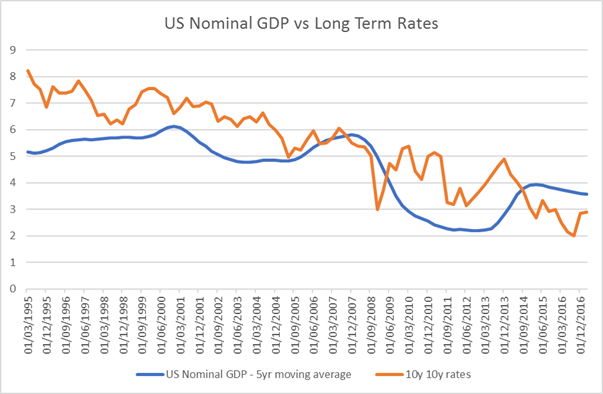
If we look at the data then, the hypothesis looks reasonable. Below is the 10-year average of nominal GDP growth alongside the 10y10y interest rate for the US. The 10y10y rate is the rate you can calculate as what the market implies the 10y interest rate to be in 10 years’ time.

Before the early 2000s, interest rates were consistently a little higher than GDP. Academics were happy with this and explained it in terms of some type of premium which bond owners would demand to own bonds. They were then confused in the early 2000s by the “conundrum” that long term yields dipped, explaining it either by Chinese ownership of Treasuries or a global “savings glut” which was forcing down yields.

Outlook for Nominal GDP

Current yields do not look very remarkable to me, but they are only correct if you think that nominal GDP will remain as low as for the past decade. The most prominent argument that we should expect this to continue comes from Larry Summers and his promotion of the idea of “Secular Stagnation” – http://larrysummers.com/2016/02/17/the-age-of-secular-stagnation/

I find these arguments a little hard to engage with as we must recognise how utterly useless long-term forecasts of anything generally are. I should admit that I am not a big fan of anything which looks like a restatement of the savings glut theory to me, but I do not want to engage here in an academic debate. As a more practical question, I think that the burden of proof is on ideas such as Secular Stagnation and the “New Normal” that the world will need permanently far lower rates than it has in the past. Arguing that nominal GDP will be lower, due to slower population growth, demographics and potentially lower productivity is easy. Explaining why it is 3% lower is not so easy.

My view is that this economic cycle does not require new theories to explain it. A financial crisis results in a very deep recession and leaves scars which mean the recovery is slower than many expect. These hangovers from the financial crisis are what Yellen refers to as “headwinds” which are slowing down the economy. Risk aversion among consumers and businesses after such a bad recession is only to be expected and the impairment of the credit channel after such a disruption is also understandable. But there is no reason to think that these headwinds are permanent. They can abate and we can return to a world similar to the one before, both in terms of the level of nominal GDP and also the relationship between interest rates and growth. The financial crisis has been traumatic, especially for countries like the US and the UK, that have not seen one like this recently. However, the history of financial crises is that they are worse than people think, but they are not permanent.

Are we renormalizing?

Unemployment fell slowly but is now down to 4.5%. wages have been sluggish but are now picking up.

If I draw the first chart again but this time use a 5yr rather than 10yr moving average then perhaps I can argue the market is reacting too slowly. Nominal GDP has been rising recently and with rising wages and inflation can easily be seen to be likely to continue to do so. If that is true then market rates are too low.

Why are long term rates still so low?

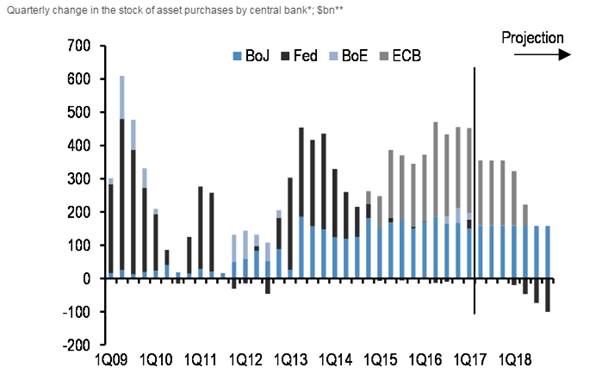
The idea that long term rates are too low is hardly new. After all this was the whole point of QE!! The central banks buy huge amounts of long term debt to drive up bond prices and yields down. This helps to stimulate the economy and boost other asset classes which look relatively cheaper to bond markets, and so drives reallocation flows.

As I mentioned in this post (https://appliedmacro.com/2017/05/01/government-debt-framework-uk-follow-up/), we are living in a new era of financial repression. Therefore, I really do not need any grand theory from the supply side of the economy to explain low rates. I just look at the huge boost in demand for bonds from the central banks.

Is there a catalyst for change?

  1. One potential catalyst would be from the front end. If the Fed hikes rates faster than the market expects, then this can cause a shock to ripple down the whole curve. We saw an extreme version of this in 1994.
  2. If wages start to accelerate then the Fed, economists and market participants would have to radically reassess their assumptions about the inflation outlook and the appropriate level of rates. If you are very confident this cannot happen, you have more faith in our understanding of this type of macro variable than I have.
  3. Even without any fundamental driver we may see a repricing simply from a change in the supply and demand dynamics of the bond market.

QE buying has been high for the past few years but it is finally slowing down. This may be the catalyst for a repricing of bonds.

Conclusion

A simple and yet historically useful framework for considering long term rates is to use nominal GDP. In recent years, we have seen the combination of a major downshift in long term expectations for both nominal GDP and the level of rates relative to nominal GDP. While many arguments justifying this change as permanent have some merit, I think that they are more temporary then current market pricing implies. Which means that I do not think that bond markets are cheap. In fact, I think they are wildly expensive.


Is Climate Science True?

If this blog were the BBC, in an effort for impartiality, I would give equal time to 2 ideas:

  1. Climate change is completely true
    Agreed by all reputable scientists and means drastic action needs to be taken immediately
  2. Climate change is a hoax
    Devised by the Chinese to limit the US economy and we need do nothing

However, I’m not bound by any such desire for manufactured impartiality so would like to ignore climate denial theories. I want effective action to be taken and I’m interested in why the first argument is failing to find broad enough support against those who want to dismantle the Paris Agreement.

The Science

I think I can reasonably simplify the scientific arguments to this:

  1. There is an empirical relationship between carbon and temperature
  2. There is a causal theory relating the two, the greenhouse effect
  3. There is no better theory, in fact no other credible theory

The criticisms for each item can be summarised like this:

  1. Poor and incomplete data
  2. The underlying system is dynamic and complex
  3. The models are not very precise with large amounts of uncertainty.

The responses I have seen to these criticism from climate change scientists are:

  1. We are collecting more data all the time. We are cleaning up the old data sets.
  2. We are building more complex models which incorporate more variables
  3. We are working to improve our accuracy with better models to reduce the level of uncertainty.

Coming from a macroeconomics background, the criticisms wouldn’t bother me much. We face them all the time. The responses from the climate change scientists do bother me however. If this reflects their research programmes, I fear they are heading in the wrong direction, sharing many of the methodological problems we see in macro and likely making the same mistakes.

My view

My preferred responses to the criticism would be

  1. Yes, the data is poor and incomplete. Not much we can do about that. We will not clean up data to pretend it is better than it is.
  2. Yes, it is dynamic and complex. Attempting to making models more complex would mean data-mining the limited data sets to produce models which are pretty but have no validity. Simple models of complex systems often work much better. Read the Borges short story (https://appliedmacro.com/2017/05/11/models/) for an elegant refutation of the idea that seeking perfection in models leads to good outcomes.
  3. Accurate forecasts are not possible because we do not have ‘out of sample’ data and associated feedback. There is little new data to use so we cannot properly test hypotheses in the way we can with weather forecasting.

The good news is that we do not need accurate forecasts because:

  1. If our model provides an unbiased best estimate and uncertainty is two-sided, then the level of uncertainly around it does not affect the policy response. Essentially the policy response will be versus the expected increase in temperature.
  1. We are providing conditional, not unconditional forecasts.
    To take an analogy, I am thinking of running the London marathon next year. Please estimate how long it will take me to run it i) in running kit ii) wearing a gorilla costume. I would strongly expect that your confidence in both of your answers is very low. However, I bet you are very confident that ii) will take longer than i).

Financial markets can be a very good training ground for learning about practical model building and their methodical dangers. Most of us have been seduced by beautiful models with great back tests with desirable correlations and high Sharpe ratios. But then trying to use them to make money, we find they had no predictive qualities at all. After enough painful experiences, we learn to be highly suspicious of any model that fits the data too well – it is the obvious symptom of data-mining. The models that work in practice are the ones that are intuitive, simple and accept that the world is a messy complicated place.

What climate change scientists and macro-economists can actually do have a lot of similarities. We do not know what the temperature will be on October 23rd 2087 but we have a good guess it will be higher if there is more carbon in the atmosphere.