Desire – The Fatal Flaw


“That’s the trouble with hope. It’s hard to resist.”
The Doctor to Missy

Desire is everywhere

I introduced the link between desire and beliefs in my last post.  As humans, this is how our brains are wired. A way to think about the human thought process is this:

Picture1

Desire is dangerous and hard to resist

Recently, we have witnessed desires replacing beliefs as the central element of the political discourse. The recent Brexit campaign was perhaps the ultimate triumph, as the debate centred on deep seated desires “Do you want to leave the EU?”

The Leave campaign focused on stirring powerful emotions, whereas the Remain campaign had no emotional resonance, relying upon things no-one cares about such as economics and facts! The level of debate was astonishingly poor because it was not really a debate at all. It was an emotional primal scream and clear evidence that desire leaves beliefs trailing in the dust.


How to combat desire

One of the ways that I combat the power of desire is to try to become consciously aware of it. If I have a belief, I try to work out if it matches with my desires. If so, I may be prone to desirability bias and note it as something to be wary, of as we mentioned in the previous piece. This is especially important for doing fundamental analysis for trading, where is can easily influence my decision-making process.

Let’s use some recent examples:

  • I remind myself to tone down the potential importance of anti-Trump developments

I read Fox News and the NY Times,
I watch John Oliver and …. OK I cannot watch Fox and Friends

  • I read the Telegraph every day during the Brexit campaign

If my belief does not match any desire I have then I note that while I might still be wrong it is unlikely this type of error. For example

  • I do not want the UK economy to be wrecked, but I think that Brexit might do it.
  • I have no particular love for the EU, but I think Brexit is a disaster.

This means that my belief that Brexit is a disaster likely comes from my analysis rather than by analysis being driven by my desires. I still have to consider other ways in which I might be wrong but eliminating the really disastrous one is the most important.

  • I would prefer that the US equity market were very cheap

So my analysis that it is expensive is disappointing but likely not driven by a desire.

Desire is a particular problem for investors

Investors are particularly vulnerable to these problems of desires influencing beliefs.
Given that our beliefs on the market require frequent updating based upon new information, any cognitive error in processing such information can often lead to poor decisions and emotion taking over. The related but more important problem is our desires as investors are not independent from the act of investing. The very act of making an investment changes our desires.

Let’s use an example is have used many times in the past 25 years.

Imagine I take you to a racetrack.
There is a race coming up and I ask you which horse you think will win.
You do not know much about the horses and so have no view independent of the odds you can see posted.
I give you £10k and say you have to put it on a horse that is 5-1. If you win you get to keep the winnings.

Now you care.
You are going to have £50k in your pocket if your horse comes in and nothing if it loses.

What do you think happens during the race? I bet you get pretty excited. When your horse is edging in front with 2 furlongs to go you are jumping up and down with excitement and are convinced you are going to be rich.

I offer to pay you £10k now to cancel the bet. You look at me as though I am crazy or trying to steal from you as you are about to win £50k. you are very confident.

Your horse tires and comes in sixth. Your horse is a well-known front-runner who tires badly. But you did not seek out that information and are shocked and deflated.

But it was pretty exciting and you can’t wait to do it again.

Conclusion

If you do not combat it what you want to believe will have a dominant impact on what you end up believing to be true. If you sit inside your bubble only listening to people you like and respect then you may be falling prey to Desire.

Decision making – systematic flaws & biases

Everyone knows that we are not hyper-rational calculating machines. We are prone to bias in how we seek out and process information. These biases are often invisible to us, but make a big impact on our behaviour and decisions. It is not only interesting but also important to understand your own tendencies, and as a trader and investor critical to improving your performance.

It also applies in the sphere of economics, where behavioural studies show that people do not behave in the way that the neoclassical “rational” person is supposed to.


Confirmation Bias

The cognitive bias that gets most attention is confirmation bias i.e. a tendency to search for and favour information in a way that supports your beliefs. This is critically important for anyone who makes important decisions. It manifests itself in a variety of ways:

  • Seek out information to support and reinforce our beliefs
  • Ignore information that undermines our beliefs
  • Surround ourselves with people who agree with us
  • Like and reward people for agreeing with us
  • Dislike and punish people who disagree with us

I remember seeing lots of these behaviours when I worked in a large organisation. Of course, you will probably see it most clearly in the people you dislike, but perhaps be rather blind to it in yourself or your friends.

In modern politics, politicians seem to be particularly prone to it:

  • Trump – an extreme case, a caricature of confirmation bias
  • Theresa May – surrounded by a small loyal group and not listening to outside advice
  • Jeremy Corbyn – adored within his bubble

It’s easy to see that confirmation bias leads to:

  • Over-confidence
  • Polarization
  • Wishful thinking

These characteristics may not be harmful to you in your life or career. That is why they can persist. For example, for many senior politicians, it has clearly not harmed their careers. Over-confidence is simply seen as confidence and that is appealing to people who want to believe in a leader. However, characteristics such as these are fatal to someone who wants to make successful investment decisions. Before I move on this in the next post, I want to introduce another source of bias that is deeper routed, more important, harder to detect and most people may even not think of as a bias!
Beliefs and confirmation bias are only one part of decision making.

Desire

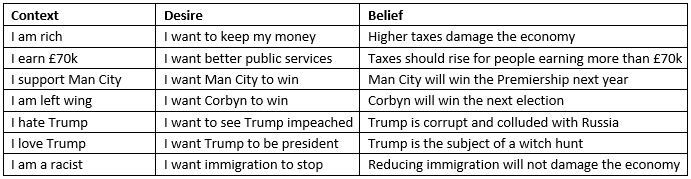
We all have desires, they are a powerful and primal part of our being. You probably think of them as part of your emotional brain but have you considered that they have a relationship with your beliefs – a bias to believe what you want to believe.

It is so prevalent the examples are legion. Here are some examples:

Capture

Of course, you can have beliefs that do not align with desires, the relationship is not deterministic. You can support Man City but think Chelsea will win, or you can support Chelsea and think Man City will win. However for the most part, it seems more natural and harmonious when our beliefs and desires do line up. If you doubt the power of desire, please spend some time to make a list of your current beliefs which are strongly at odds with your desires. I think the list is not so easy to come up with.

It is then important to consider what drives what in this relationship. There was a recent study in which psychologists (Tappin, McKay and Leer) designed an experiment to separate beliefs from desires. They gave opinion poll data to US voters and what they found was that desires dominated. For example, optimistic Clinton supporters and pessimistic Trump supporters both believed that Clinton would win. When given new polling information suggesting that Trump would win the Clinton supporters ignored it and the Trump supporters incorporated it to become more optimistic. https://www.nytimes.com/2017/05/27/opinion/sunday/youre-not-going-to-change-your-mind.html. They called this “desirability bias”.

It is how our desires and beliefs interact that make this effect so important:

  1. If our desires and beliefs are aligned
    Confirmation bias will be even stronger.
  2. If our desires and beliefs are not aligned
    Then we change our beliefs!

Often confirmation bias is easy to spot, but the desires that predispose you to seeking confirmation bias are hidden and much more important.

This result is not surprising to anyone who has worked on a trading floor or played high stakes poker. The strong emotions and desires that come from the large sums of money involve permeate the environment and can easily overwhelm most people. For a trader or investor to be successful you need to be able to make good decisions. If you have a significant bias in your decisions making then you will fail, sometimes catastrophically.

Conclusion

Your desires will have a huge impact on your beliefs, how you process new information and the decisions you make. The problem is most people believe that their beliefs are rational and do not understand their often-emotional core. Developing ways to deal with this can have a dramatic impact on your performance. In the next post, I will talk about some ways I have dealt with this in my career.

The misuse of Correlation part 5 – Hedging and Portfolio Management

For macro trading, thinking about how one asset moves versus another is important.
To this end, correlation is most commonly calculated using daily changes. The results of a reasonable relationship might look something like this:

Hedging

This concept is particularly useful if you are a market maker, or anyone in need of a reasonable short-term hedge for your risk. However, if you are holding for a longer period, the potential difference in the trends (the means that we touched on in part 1) are likely to dominate your returns, irrespective of the correlations.


Portfolio Risk

For constructing portfolios, measures like VaR (Value at Risk) are often used to explain and think about risks. The inputs to these measures usually take daily returns.

This can lead to problems with serious consequences if you are using this analysis to understand the risk of a portfolio you are planning to hold for a longer period.

In this chart, I take a selection of major markets that a typical macro portfolio may contain: major currency pairs, interest rates and the S&P.
I plot the correlations of the pairs calculated two ways:

  • Return Correlation up the X axis
    Taking daily changes as we did previously
  • Price Correlation up the Y axis
    Looks at the correlation of the levels of each price series
    (i.e. if both assets went up over the year, implies high positive correlation)

The results are important for the construction of a longer-term macro portfolio. Take 2yr US rates and USDJPY as an example:

  1. Daily return correlation is decent around 50%
    If you are long USDJPY and you add an opposite US Rates position,
    Overall portfolio reported risk would therefore decrease

If you hold the portfolio for one day it is reasonable to expect that your hedge will act to reduce the volatility of your returns.

  1. Price correlation is actually negative

As above your reported risk is determined by the daily return correlation and decreases.

But if you took the supposedly offsetting position above, at the end of year If you lost money on USDJPY, you would have lost on your “hedge” too
The “hedge” would have reduced your reported risk but increased your return volatility on a one-year horizon.

So what does a “good hedge” look like?

Two plausible but very different definitions seem clear:

  1. High correlation of daily changes
    Consistent with VaR and best hedge for VAR, short term traders, market makers, options traders (delta hedging). A lot of option hedging is done via proxies and this is the type of statistic they would care about.
  1. Long term hedge
    Much more important for longer term position such as a macro hedge fund, a pension fund or your personal portfolio. There a hedge would mean that if you hold both assets for a year they would have similar (offsetting) P+Ls

The above analysis shows how different these two time horizons can be. The big risk we face as portfolio managers, is that we do too much of the analysis based on short term price changes, which links conveniently to VAR style risk reporting. This gives a completely misleading guide on the long term P+L risk we are actually taking.

Conclusion

In these pieces, we have seen that Correlation is probably not what you thought it was.
Correlations are used in risk reporting (as we have mentioned here) but also in Portfolio Theory, CAPM and how an investor should think of designing a portfolio.

This topic has important ramifications for many areas of modern finance and I will return to it later.

The Misuse of Correlation Part 4

Continuing from the previous post, I’m looking at issues and common mistakes arising from the use of the word correlation.

  1. Uncorrelated does not mean unrelated
  2. Correlation does not imply causation
  3. Correlation is not transitive
  4. Data issues

We have covered number 1 and 2 already.

  1. Correlation is not transitive.

In my post on significance, we covered that only some relationships are transitive.
For example, weight is a simple example of a transitive relationship

  • If Adam weighs more than Bert
  • And if Bert weighs more than Charlie
  • then Adam weighs more than Charlie.

But, just as for significance, this is not true for correlation.

Modern medicine gives us many clear examples

  • High cholesterol correlates with higher risk heart disease
  • Certain drugs (e.g. statins) correlate to lower cholesterol
    Therefore
  • Certain drugs (e.g. statins) correlate with lower risk of heart disease

Correlation is not transitive so this is a common logic error.
We have to study the direct relationship of the drug and heart disease to see. But by the time the statins advice was given, trials were still not conclusive. Respecting this problem makes proper drug testing expensive and difficult, but ignoring it, makes writing an article in the Daily Mail really easy.

I saw a similar result in the news recently.

  • Taking aspirin correlates to lower risk of heart attack
  • Heart attack correlates to early death
    Therefore
  • Taking aspirin correlates to lower risk of early death
    However, having trialled this with real patients, the results found
  • Taking aspirin also correlated to fatal internal bleeds (especially in the elderly)

Doctors are now much less confident in their original advice as the number of deaths, due to taking are thought to be material, so other factors must be considered.

Not only is this relationship non-transitive, but it’s clear how complicated the real world and overly simple results from correlation may be very misleading.

Similar examples we see in financial markets.
Let’s build a basic model for the oil price using two drivers, inventories, and the US dollar. If I run a regression of the over 10 years, I get a correlation coefficient:

  • 0.78 for the oil price and the level of inventories
  • 0.44 for the oil price and the US dollar.

What do I get if I do a regression of oil inventories and the US dollar?

  • 0.04 i.e. virtually no correlation at all.
  1. Data issues

A. The problem of selective attention

“How not to be wrong” by Jordan Ellenberg mentions this good example of Berkson’s fallacy.

“Why do literary snobs believe that popular books are badly written?”

  • Let’s imagine a world in which half the books are popular and half the books are unpopular.
  • Only 20% of the books are good with 80% being bad.
  • Let’s make no relationship (correlation) between those two variables.

We would get the grid below:

However, who pays attention to books which are both bad and unpopular?
No one

From a literary snob’s point of view, you can redraw the grid with only the books they are conscious of existing (i.e. the unpopular bad books are in a blind spot)

The grid they perceive looks like this:

In this case, they see the important statistics as

  • Half of good books are unpopular (10/20)
  • 80% of popular books are bad (40/50).
  • A bad book has a 100% chance (!!) of being popular (40/40)

Conclusion “people have terrible taste and to make some money I should write a bad book!”

Given the perceived data set, this conclusion would be solid. But looking at the entire data set, it’s clear that they are making a mistake.

We are in danger of doing this all the time in economics and finance. But finding a good example is hard as the whole point of a blind spot is that we tend to be unaware of it.
What is clear is that the choice of data set is critically important, and likely a far more important choice than the sophistication of the statistical tools you later apply.

B. Choosing a time window

A related and common problem in financial markets analysis is the biased selection of data.
As I wrote about more fully in Significance (https://appliedmacro.com/2017/06/12/the-misuse-of-significance/), analysts often want to produce statistics with compelling results.

For correlation type analysis, the most common trick is the selection of the time window. If we take the short and long-term interest rate example from Part 1 “Uncorrelated does not mean unrelated.” We observed that the correlation is very close to zero for the last 5 years. However, if we extend the time window to the last 15 years, the correlation increases dramatically to 0.84 which is a decent relationship.

Conclusion

In these posts, I have discussed a number of ways in which correlation analysis is misunderstood and misused. Analysts often know these issues, but they still manage to fall into the traps. I have certainly been guilty of making all the mistakes above many times! I have tried hard to train my analysts to watch out for this sort of error in their work and encourage them to look for it in the work of others – it can be hard to spot once you’ve already worked hard on something.

Of course, these are not the only errors made with correlation in finance. The more serious mistakes follow from a more profound misunderstanding of correlation which took me many years and a lot of painful experiences to gain an appreciation of. I will turn to those in the next post.