Feedback

As a member of many teams over the years, both leading and contributing, I have learned a lot about feedback. How it is dealt with is a core aspect, not only of work culture, but also in all our relationships. In this post, I will deal with the kind of feedback which is meant to have a purpose, that of improving performance, often thought of as coaching.

Coaching is at its most useful when it is an active exchange of mutual learning. On the one hand, I find I learn so much trying to explain concepts to others, whilst on the other hand I very much enjoy the experience of being coached myself. Effective coaching is rarely dominated by telling people what to do.

Encouraging self-reflection and evaluation within a context of mutual respect and desire for improvement are critical to achieve progress. You cannot presume that someone wants a coaching relationship with you, and they may perceive attempts to coach them as unwarranted criticism.

I think it is helpful to break feedback down into 3 types: praise, encouragement of self-reflection and evaluation, which can be either objective or subjective. It is also important to make a distinction based upon the type of relationships or power dynamics involved.

This leads to a grid, similar to the one used in “How to Write”.
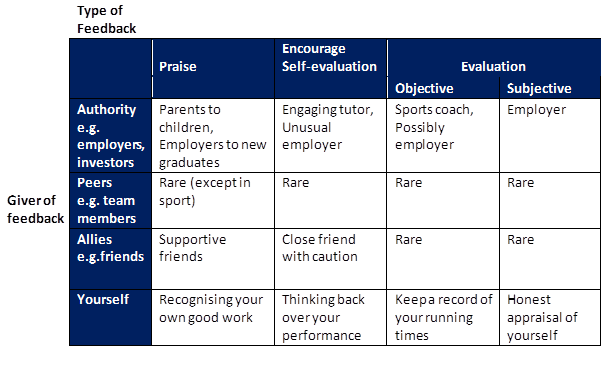
Type 1 – Praise

Very often when people say they want feedback, they only want praise and it quickly becomes a vacuous form of feedback. We have all heard the disparaging stories of “millennials” who are conditioned to expect it. Indeed, I have come across this problem with juniors but I feel anyone adjusting to the world of work, especially straight from university, may find the real-world environment a challenge. I probably did myself.

People who have had a career in a more protected environment, or who have low self-esteem, may also need frequent reassurance that their work is valuable. We see that praise is the only form of feedback that Donald Trump can tolerate. Whereas seasoned and successful professionals tend not to seek praise as much. They know that when validation of their work comes, it is well deserved but their self-esteem is strong enough not to require it.

Like most people I enjoy being praised, but If I am highly praised for something I do not consider particularly worthy, then it has very little meaning to me. My greater desire is to learn and improve, so I actively seek other types of feedback. However, I do believe that praise is underrated as a feedback tool and it can be a very effective form of teaching, positively reinforcing good behaviours if used selectively. This is the way that I like to use it and to receive it.

As parents, praise is totally natural, we proudly clap our children at the slightest provocation. Children are naturally experimenting with behaviours and desperate to learn through new experiences, so selective reinforcement is very powerful. Genuine strong praise for a child who has tried hard at something is mutually rewarding and comes very naturally.

Overall, my approach is to try to use praise genuinely, but it is not as easy as it sounds. At work, I often start with praise but mix in other forms of feedback. This often carries the risk that the recipient may not hear the praise at all, and in fact perceive the whole conversation as pure negative criticism, especially given our power relationship. Furthermore, where the need for praise is too strong, then validation becomes an obstacle to learning in itself. If they receive a lot of praise, then why change behaviour?

A general principle is that people tend to give out the type of feedback they like to receive themselves. If I am managing a person who only wants praise, I struggle to manage them and these relationships have not worked for either of us

Type 2 Encourage self-evaluation

This is simply asking someone their thoughts on what they did or how they feel something went.
This is a type of feedback that may not register as feedback to many people, it does not involve any praise or criticism, no evaluation or active coaching.
The idea is to encourage reflection and to start a conversation from which you both can learn.

This style of feedback comes naturally to me and is most enjoyable if the other person wants to participate. Receiving this type of feedback from investors, it led to the most enjoyable and engaging conversations and I think I learned the most.

Remember the most common source of this form of feedback is yourself!

Type 3a Evaluation – Objective

This is a very important type of feedback if you can get it.

In modern sport, virtually every facet of the game is reduced to statistics which can be measured and help form the development of training drills to enable a player to improve. Purposeful practice requires a solid feedback mechanism.

Learning without a reliable feedback mechanism makes objective evaluation much harder. Learning to trade for example. A market making environment lends itself to objective evaluation as the number of transactions is likely to be high and the speed and accuracy of pricing can be easily observed. But it is one of the reasons that learning to trade by taking risk in markets is difficult, as in the short term the element of luck is large enough to create noise in the consequences of your decisions.

If evaluation is clearly objective and applied transparently to all staff, then it is likely to be accepted. But the attractions of this type of feedback are also its drawback. It is appealing to generate objectives which are measurable, but not necessarily relevant to the goals of the organisation. Think of the Blairite obsession with targets in health and education, which created distortions in incentives.

Type 3b Evaluation – Subjective

Subjective evaluation is the most overused form of feedback, and most people seem to think this is what feedback is. If you look at the forms that HR demand you fill out for conversations with your staff, you will see the word evaluation everywhere. This is often combined with a requirement to assign scores or rankings to various aspects of the employee, creating the illusion of objectivity but they are actually the opinions of the manager.

Subjective evaluation may have a place. If your intent is to make a complaint then this can take the form of a negative evaluation, for example if you want to complain to a hotel you can give a low rating on TripAdvisor. But there is wide variation in the quality of such comments. In large firms however, negative evaluations are used almost exclusively as part of the process of firing employees.

When I ran a large fund, I had hundreds of investors, old and new, continually evaluating me. If I agreed with the evaluation, it was likely it became an experience of being berated rather than a learning point. If I did not agree with the criticism, I still had to take it.

In close work environments, the giving and receiving of such feedback can be a minefield. It can be hard to receive emotionally, especially when the receiver doesn’t accept the view or worse the right or competence of the person to evaluate them. Unsolicited feedback is pure criticism – no one likes to be criticised. This is why, in practice, most work evaluations turn into exercises of giving praise, even when it is not genuinely deserved.

The relationship matters

What is striking about the workplace is how little useful feedback is given and/or taken.

If you are the in a position of authority, care must be taken not to blindly hand out feedback that could be construed as pure criticism. Remember anything you say has a magnified impact, given the nature of your relationship. Consider layering in the various forms of feedback I mention, remember the idea is to help your employee, not to add unnecessary strain or distance.

If an employee receives feedback that they don’t like, it can often be seen as confrontational or rude, and instead of trying to work out what was the purpose of such feedback the employee is more likely to grumble about them behind their back. A very poor outcome for both parties.

If you are a person who wants to improve, you need to actively seek out feedback from people you respect, this is key to improving performance. Avoiding criticism is an ingrained social habit, so bear in mind you need to be prepared for an honest evaluation. Keeping any defensive reaction in check is important as if you react defensively, you are likely not to hear honest feedback again. You should thank the person for the feedback and do your best to understand it. If you think it is completely wrong, then you still have an important learning point, that someone you respect perceives it to be true.

Conclusion

How to manage feedback is one of the most important aspects of work culture and defines whether your organisation is going to merely stagnate or rather learn and develop.

As a giver of feedback, it is important to recognise what kind of feedback the person wants and will be able to process.

As the receiver of feedback, you have the main power. You can be defensive and only accept praise, or you can actively solicit opinions which you can incorporate into your learning process.
Money 2 – an alternative history

In the beginning, there were people….
People have social interactions which have very strong patterns. One of these patterns is the concept of Reciprocity. If someone gives you something you have a strong sense of obligation to give them something back. This forms the basis on many successful marketing strategies (see “Influence” by Robert Cialdini) but also sits at the heart of everyday social interactions.

For example, in the office someone makes coffee for you. This creates an implicit obligation which you will wish to later reciprocate, or perhaps “repay”. In fact, the word “pay” is said to come from Latin “pacare” meaning “to pacify” and later came to mean to settle a debt. You do not immediately barter, need to give something in return at that time. You have a social relationship and there is mutual trust that this obligation will be repaid. This obligation could be called a “debt” or a “liability”. The person who made the coffee now can be seen to be holding an “asset”.


Make it more useful by adding features….

This method of economic organisation works well for small items between tight-knit or homogenous groups. But it would be far more powerful if we could add some other features which allow us to expand it:

  1. Unit of measurement.
    It is handy to be able to quantify the economic value of the transaction so that more complex exchanges can be facilitated
  2. A method of recording ledger items.
    Just remembering that it is your turn to buy doughnuts for office is not sustainable for more complex economic transactions.
  3. Tradability to a 3rd party
    It would be great to be able to have the favour repaid by someone other than the recipient.

A voucher system….
So let’s start a voucher system. Every time you do me a favour such as babysit my kids I will give you a voucher. Every time I do a favour such as mow someone’s lawn I will be given a voucher. I can build up a stack of voucher from doing these jobs and then “spend” them by taking my family to a restaurant for dinner.

This system of money can be seen today in small areas. In the UK, there is the Lewes pound and the Brixton pound. Tight-knit communities can develop all sorts of formal and informal social conventions to regulate exchange. None of them require gold. These are the sorts of systems of money found in ancient, primitive societies. There is no strong archaeological evidence because this kind of money is not physical, however the earliest writing ever discovered was on tablets thought to represent ledger type records. Tokens in the form of Coins are in fact a later discovery and this has commonly been misunderstood as thinking that it was the tokens themselves that were the valuable item. In fact, it was and is the social obligation that matters, coins were simply a means of recording it.


Using a central authority to widen the usage….

But these local currencies or voucher systems have limitations. They rely on trust which is hard to foster with strangers. It would be much more powerful to have some authority or government to issue the money and guarantee its use across a broader area. This is when we see minted coins by a sovereign.

The unit of value can be solidified by collecting taxes in that unit. You will notice that you owe your taxes in US dollars in the US, and in pounds sterling in the UK. The benefit to society is huge, economic activity can be distributed and exchange facilitated on a grand scale. There is also a large benefit to the government, as issuer they get to earn seignorage.


Conclusion

The alternative story of money is still taught, but these days it is mainly in sociology, history or anthropology departments. This version has been eradicated from economics faculties and treated as “fake news”. Economics students are not taught arguments to support their story, it is simply assumed and most are even unaware there are other ideas.

First Order Approximation

I used this phrase in a post two weeks ago (Models – How do computers play chess?), and in causing some debate, has made me realise how it has both subtle and important differences in meanings. This has implications for how we approach problems and links to some of the root causes of mutual incomprehension that I often come across.


Some of the different meanings:

1). General usage
It is the same as “first approximation” or a “ball park estimate” and used interchangeably. It is an educated guess with a few assumptions and likely a simple model. I think this is the most common usage. It tells you nothing about the nature of the model as this will vary by context.

2). Engineering/physics
Often used as an indication of level of accuracy, like significant figures, and this accuracy improves with higher orders of approximation. For example, if estimating the number of residents of a town the answers could be:

1st order approximation / 1 sf 40,000
2nd order approximation / 2s.f. 37,000
etc.

3). Mathematics
1st order often refers to linearity. For example, a Taylor series of a function of the form:

1st order approximation a + bx (also called a linear approximation)

2nd order approximation a + bx + cx^2 (also called quadratic)

Order also exists in statistics, with arithmetic mean and variance known as the first and second order statistics of a sample. Skew and kurtosis are third and fourth order and can be thought of as shape parameters telling how far from the normal distribution you are.

4). Financial derivatives pricing
For option pricing, it refers to the order of differentiation, so is helpful when thinking about sensitivities in the change in price:

1st order approximation Delta (1st derivative of price with respect to underling price) 2nd order approximation Gamma (2nd derivative of price)

For bond pricing, second order approximation is also called convexity adjustment which again is used to help understand the non-linearity of bond prices.

5). It can refer to the number and importance of the variables in a model.

A first order approximation may only deal with primary drivers. A second order model would include secondary drivers used to refine the estimate.

For example, a first order approximation of the time taken for a ball to drop would be to use Newton’s second law, F= ma. A second order approximation might include some appreciation of wind resistance.

The meanings may not align

These definitions might appear to be much the same thing. You can easily argue that a simple linear model using only the most important drivers will produce a decent ball-park estimate to one significant figure.

But this apparent similarity of definition means that a common trap is to not notice when they are different.

  • A first order approximation can be quadratic

To estimate the height of a cannon ball after firing we need to draw a parabola not a straight line. Often the non-linearity is so important that any linear model is awful.

(see How Not to be Wrong: The hidden Maths of Everyday Life by Jordan Ellenberg).

  • Making estimates more “accurate”, using higher power terms may make the model worse
    In maths or physics textbooks, this approach always works out given that you already know the mathematical function or have an underlying relative which is stable. But in the world of economics and finance it can lead to a huge methodological error, thinking that the better our model fits the data the better the model. I worked with many analysts who have struggled with this and kept producing models with wonderful correlations and R^2. This leads them to think they have a model which “explains” the price action as well as possible. But these models are invariably useless, have no predictive value and need to be “recalibrated” to make them refit new data as it comes in.
  • It takes judgement to know which variables to use.
    For instance, in the example with dropping an object, Newton’s second law will do an excellent job on a ball bearing from 10m but a pretty poor job on a parachutist. Which drivers will be important in financial markets varies over time and it takes a lot of flexibility to stay open-minded as to potential outcomes.

Money 1 – A Creation Myth

In this piece, I take “Macroeconomics” by Greg Mankiw, the bestselling undergraduate textbook, as the source for this story.

A history of money

In the beginning, there was barter
and a rudimentary economy was based on it. This is extremely inefficient as you have to walk around all day carrying lots of goods, hoping you bump into someone who has something you need who at the same time wants something of yours and will trade you for it.

Efficiency demanded the use of commodities….
Given how poorly organised this world would have been, “it is not surprising that in any society, no matter how primitive, some form of commodity money arises to facilitate exchange”. “Most societies in the past have used a commodity with some intrinsic value for money”. We can see this because archaeologists have found lots of gold, silver and copper coins from previous civilisations.

A really nice example of recent commodity money is the use of cigarettes for currency in a POW camp in WW2. This is an excellent example of why commodity currencies existed and how they operate.

As society evolved thus did “fiat money”….
A modern development in the history of money is the development of “fiat money” which is “money that has no intrinsic value”. This occurs via a process of “evolution from commodity to fiat money”. The process by which this happens is rather mysterious but “in the end the use of money in exchange is a social convention: everyone values fiat money because they expect everyone else to value it.”

Modern money

Money is the stock of assets that can be readily used to make transactions” and it can be defined by its uses which are:

  1. Store of value
  2. Unit of account
  3. Medium of exchange

Between history and mythology

Unfortunately, as so often is the case with creation myths, none of this is actually true. Understanding what money is and why economists are taught its history in such a strange way is important. In fact, I would say it is central to understanding current economic policy and also how best to invest.

Myth #1 In the beginning there was barter

There is no evidence of any society has ever used barter as their primary means of exchange. This should be unsurprising as it would be horrifically inefficient.

Myth #2 Commodity money was the primary form of money for most of history

This myth is more serious and way more pervasive.
However the evidence from the existence of coins far from backs it up, I think it is good evidence of the opposite.

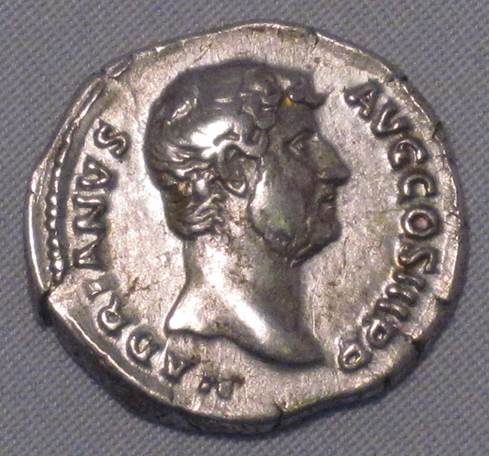
Imagine we are in ancient Rome and we have a Denarius coin in front of us
(Deni from Latin “containing ten” originally was the value of 10 asses)

It has a nice picture of Hadrian on it, “he” of the wall.
It was made of silver and so has an intrinsic value from its weight in silver
(there are examples of use of gold in coins too – the history is interchangeable)

Consider this, let:

A= intrinsic melt-down value of the coin

B= face value on the coin

Then scenarios are:

A > B the coin would not exist, it would be melted down.

A = B why mint it in first place? Why bother calling it a Denarius at all and put the Emperor’s face on it? It would be simpler just to weigh it. There is no benefit for the government to go to the trouble and expense of minting these things.

B > A Now there is a reason to mint it – a profit! The difference (B–A) is known as “seignorage”. We know this was a main source of income for monarchs for centuries from records. But if B>A then there is no strong link between the intrinsic value of the metal and the value of the money. It sets a lower limit but nothing more.
So what is the difference to fiat money? Not much. History indeed has little evidence for a prevalence of commodity money.

But what about the example of cigarettes in the POW camp?
I love this example because it is correct, and utterly misleading. There is an important reason why a commodity currency was used. It is because there was no way to enforce an obligation as the members of the economy were not in control of their society (see below for why this matters).

Myth #3 Money is an asset

Money is not a thing, or an asset like any other asset in the economy. It is much more special than that. It is a ledger item which always consists of an asset and a liability which come into existence at the same time. There is nothing else like it and it is central to the functioning of the economy. I will delve into this in the following posts.

A common error when struggling with such an abstract concept, it is often much easier and more natural to think in tangible terms. An analogy for this is units of measurement. It is now “obvious” that the concept of measurement is conceptually separate from any physical object. I can separate the concept of “1 metre” from the physical reality of a “piece of metal 1 metre long”. Although it is hard to imagine than this was not always obvious for humans, it was certainly not the case in ancient societies. In fact, it is striking how well these societies were able to operate, before the concept of number being separable from their physical objects, allowed formal arithmetic.

Myth #4 Money can be defined by its uses

This myth is again common but is a non-unique definition for money. There are many, many assets which could be used for the functions:

  1. Store of value
  2. Unit of account
  3. Medium of exchange

For example: dollars, gold, bitcoin, cigarettes, diamonds, canned food, oil etc.
In fact, anything non-perishable as bananas would not store well. The concept that in a mainstream economics they assume that anything can be used for money is important. Economic theories have developed from it, often containing the hidden assumption that money is not special and can largely be ignored. It is an asset like any other asset, is priced in the same way as any other asset. Therefore we should not be surprised that all the output from these models show no important role for money in the economy. I would have hoped the financial crisis would have exposed this as a myth.

Myth 5 Fiat money is a modern development

In fact, it is the oldest form of money.
I would prefer to say that “fiat money” means “money” and that “commodity money” is best defined simply as a “commodity”.


Conclusion

The story of money taught to economics students contains many a myth.
Next, I will tell an alternative story of money. The ideas I will present are not difficult.

But as Keynes said, “The difficulty lies not so much in developing new ideas as in escaping from old ones.”