Games 1 What is a Game?

Skill and chance

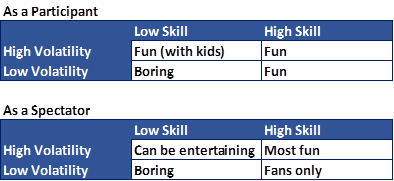
A common way to think about games is that they are either games of skill, like tennis, or games of chance, like roulette. But this basic categorisation can lead to some important misunderstandings. A far better way to categorise them is in two dimensions, skill and volatility.

Introducing Skill and Volatility

Games can instead be categorised as having:

  • High Skill – where the result is importantly impacted by the relative skill of participants.
  • Low Skill or Unskilled – the result will mostly likely be to chance (Random)

We can also categorise them by volatility of outcome:

  • High Volatility – The winner and margin of victory of any particular result will be variable and somewhat unpredictable
  • Low Volatility – The margin of victory will be similar each time the game is played.

By “game” I’m using a fairly general definition – any competitive activity where you can judge who is the winner and often how easily the win was achieved. Games such a chess and poker, competitive sports such as football and tennis would clearly fall under this definition but similarly so can trading and starting a business.

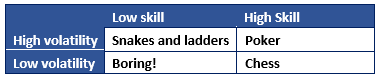
This approach yields a 2 by 2 grid:

Picture1

Let look at some examples for each quadrant:


Low skill element combined with high volatility

e.g. Snakes and ladders, roulette

Snakes and Ladders is clearly a game of chance with no skill but is surprisingly fun to play with kids. Climbing ladders ahead of the competition or sliding down huge snakes and losing your lead produces a lot of drama and excitement.

Games of no or low skill and high volatility make excellent games for young children. They are also quite common for adults but generally when money is added to the equation as they make popular gambling or casino games.

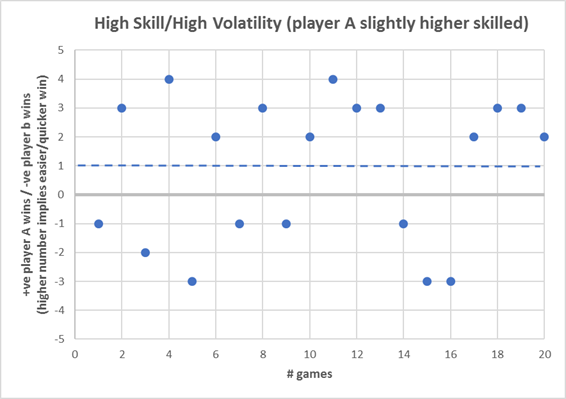
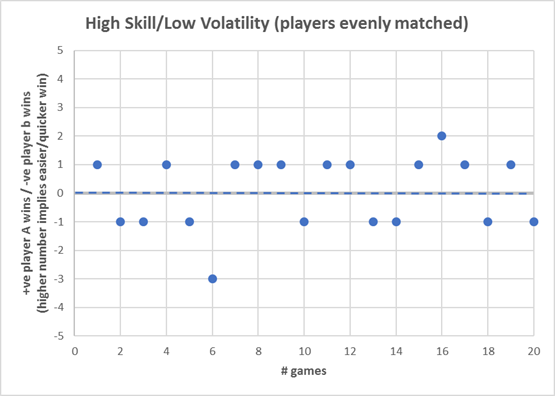
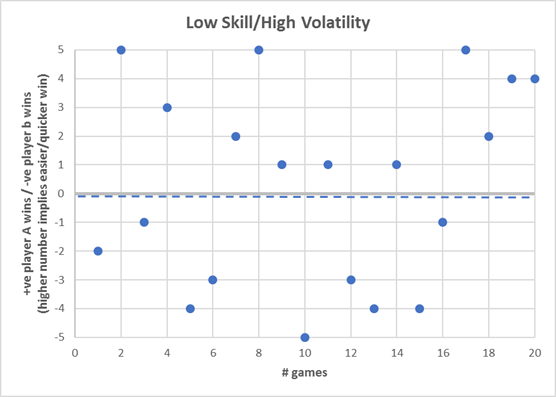
If we consider the distribution of outcomes of 20 matches played between 2 players, it might look something like the scatterplot below:

  • X axis is each game played.
  • Y axis is the result.
    Above zero signifies player A wins, below player B wins. 1 would signify a tight match, 5 would signify a relatively easy victory. In this case, we do not have draws – zero scores.


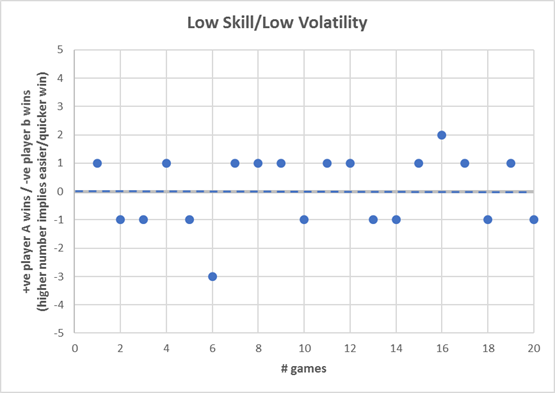
Low skill element with low volatility
a very boring game!

Snakes and Ladders without any snakes or ladders would be an example of this. The winner is the person who on aggregate throws the higher score when rolling dice. This seems extremely dull and not something that people would do for a purpose or for enjoyment.

High skill element with low volatility of outcome
e.g. chess, Go


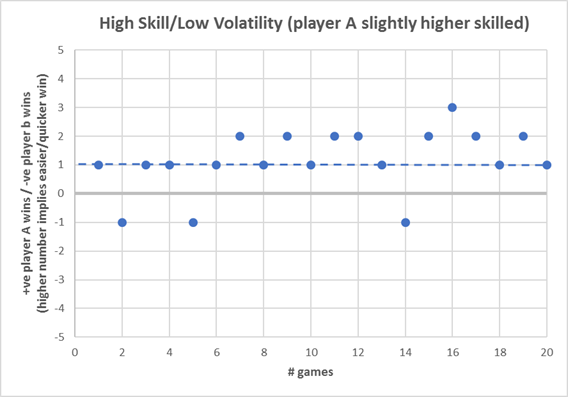
Here the skill element dominates relative to the volatility of the outcome. In this category, we find
chess and Go and sports such as tennis. A significantly better player is almost certain to win and, in that respect, these games often do not work well socially as weaker players have little chance of winning so will not enjoy very much. These are the games I work hard at to become expert and enjoy fierce competition with players of a similar standard.

Non-random with high volatility
e.g. pool, poker

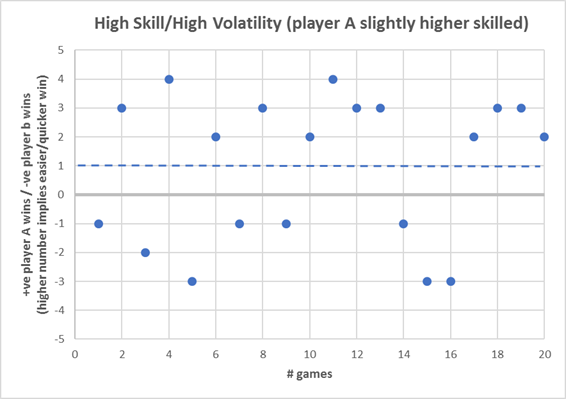
This is the category that holds the most socially fun games. The skill element is undeniable but the outcome is uncertain enough that the lesser skilled player still has a chance to win. The uncertainty may even be sufficient that the weaker player may consider themselves the stronger one.


Volatility the key ingredient

People tend to be somewhat aware of the skill level of games. They tend to be less aware of the volatility of the game and why it matters so much.

Pool is a lot more fun to play socially than snooker. Both involve almost the same skills, but pool has much higher volatility. A better snooker player will take virtually every frame; but with a similar difference in skill the weaker player would still win some games of pool.

Golf is another game with high volatility and high skill. Even top professional golfers can have a range of 20 shots between their best and worst rounds. On any given occasion, players of slightly different standards can play together uncertain of the outcome, although they know on average who will come out on top.

Summary

People play games of many different types. It is easy to view them simply as either random or skilled but this misses important distinctions. Adding volatility into the framework brings into focus the differences between say chess and poker, fundamentally different games and enjoyable in their own ways.

The Backfire Effect

Recently in the news

  • You may find it puzzling that Republican voters are still backing Trump.
  • You may be amazed that the same voters do not believe that Russia interfered with the election, or that there is any connection to the Trump campaign.
  • In that case you must be shocked that the recent Donald Junior revelations have make their belief in ‘no collusion’ even stronger.[1]

But then again, is it that surprising? I previously discussed confirmation bias and desirability bias (https://appliedmacro.com/2017/07/10/decision-making-systematic-flaws-biases/ and https://appliedmacro.com/2017/07/12/desire-the-fatal-flaw/)) but in this case feels like there is a different driver at work.


“Backfire effect”

This recent paper [2] found that “direct factual contradictions can actually strengthen ideologically grounded factual beliefs”. This is the “backfire effect”.

In contrast to what we saw previously:

Here we have:

The more evidence and the clearer the evidence against Trump, the more strongly his supporters believe him innocent. Trump supporters are not backing him because of facts or policies, this is about ideology and culture and it is a battle. Facts are irrelevant.

There are plenty of examples which demonstrate this. Tim Harford talks about how the tobacco industry managed to delay regulation for decades despite overwhelming evidence showing the link between smoking and cancer. [3] Another favourite example is what happens to cult members who believe that the world will end on a specific day. They give away their possessions and prepare for their ascension to heaven/alien spaceship. When the day arrives and nothing actually happens, they do not lose their faith; their faith in the end of the world actually increases. Perhaps the “backfire effect” also explains why Tony Blair’s support for the Iraq War became more fervent despite mounting evidence against the entire premise.

Back to Trump-gate

Given this, I fear that this ever-larger number of smoking guns will not help the Democrats much, even with increasing suggestions of criminal activity not just from the Trump campaign but from the Trump family itself. The way to defeat the Backfire effect is not to counter with ever more evidence. There was no possible evidence based argument that would have changed Blair’s mind about war.

The best approach is to build a compelling alternative narrative. Corbyn did this very successfully in the last election, making no attempt to defend himself against May’s attacks, focusing only on what he wanted to talk about. He did not change people’s minds about Trident, he stopped them thinking about it. What we focus on is far more important than the content of the debate.

Like all cognitive biases, spotting them in others is far easier than in oneself. We can all fall foul of the “backfire effect” when it comes to our most central values and beliefs. For business and investment, it has perhaps led to the most catastrophic of errors. The disasters of RBS, Lehman and Enron can be traced to core beliefs that proved successful at first, but then warning signs were ignored as the management became ever more evangelical in their confidence that their path was the right one.

When we are looking for investment analysis or advice, then we should be very wary of those with high and unchanging conviction. Some of the ones I regularly come across: the EU will break up/stick together or China will implode/ take over global dominance or the bond market will crash/inflation will never return. They argue passionately and eloquently (they are well practised) but are the ones most likely to be victims of the “backfire effect”. The element that makes them so popular as guru strategists and TV pundits makes them highly unreliable sources of investment advice.

Perhaps we should simply recognise that we may easily fall for this as individuals, but by building diverse enough teams and open enough culture, we may not fall for the same cognitive flaws.

Summary

As with confirmation bias and desirability bias, the “backfire effect” is important and can warp your interpretation of the world. Your political enemies and people you do not respect will not be the only victims of this. We can all fall prey to it and should be most sceptical of our views which are most closely linked to our core values and beliefs.


[1] http://www.breitbart.com/big-government/2017/07/16/just-nine-percent-republicans-think-trump-russia-collusion-abc-wash-post-poll/

[2] http://www.dartmouth.edu/~nyhan/nyhan-reifler.pdf

[3] http://timharford.com/2017/03/the-problem-with-facts/

Are Golf Handicaps Fair?

I played in a two-day golf tournament recently and had a conversation about whether golf handicaps were fair, even for completely honest golfers. As I thought more about it I realised that they are not, but not always in the ways I had imagined. I was aware that both high and low handicappers often thought the system was biased against them. I had not realised that depending on the circumstances they were both right.

What is the handicap for?

According to the USGA “the purpose of the USGA Handicap System is to make the game of golf more enjoyable by enabling players of differing abilities to compete on an equitable basis.”

http://www.usga.org/Handicapping/handicap-manual.html#!rule-14367

But it does not simply create a handicap by taking an average of your scores. It “disregards high scores that bear little relation to the player’s potential ability”. The method mixes up the ideas of “equitable” with “potential” which has profound implications for which golfer should expect to win.

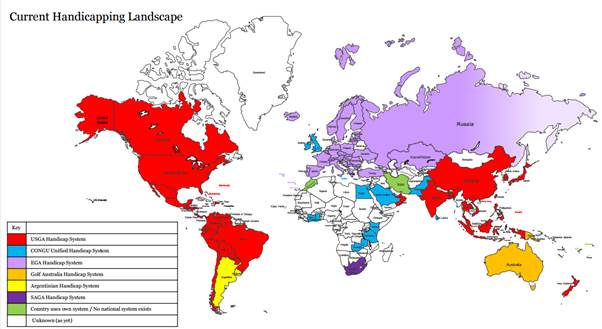
Note I will use the USGA system in this post as it is the system I understand the best. It is worth noting how many different systems are currently used across the world. These other systems will have some impact on the “fairness” but the key points are true for all of them.

How is your handicap calculated? (slightly simplified!)

  1. Take your score on a full round of golf and adjust it slightly by eliminating any very bad holes. For example, an 18 handicapper records any hole which is more than a 7 as a 7.
  2. Enter your last 20 adjusted scores and compare them to par e.g. if you have a score of 82 on a par 72 course this is 10 over.
  3. Take an average of your best 10 scores compared to par. Ignore the worst 10.
  4. That is your handicap

The same mathematical process has been performed on both players’ data to adjust their scores. Does this mean that the result is fair?

The problem is that the way that golfers of different abilities vary is not just in their average score. They also have different volatilities. A low handicapper has a far more consistent game, which translates from consistency on each shot to each hole score to each total score per round. This difference in volatility of the players has a big impact on who you should expect to win.

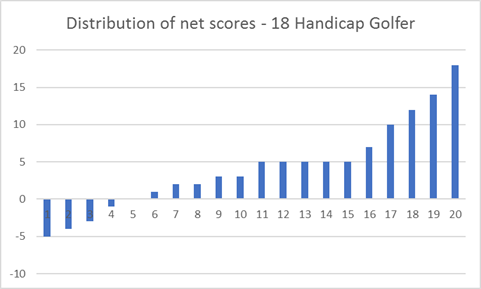
Let’s take a simplified case to illustrate the issue. Let the scratch (zero handicap) golfer have zero volatility i.e. they shoot level par gross and net every time. Let the 18-handicapper have a more realistic (and obviously higher) volatility of score.

Head to Head – low handicapper wins

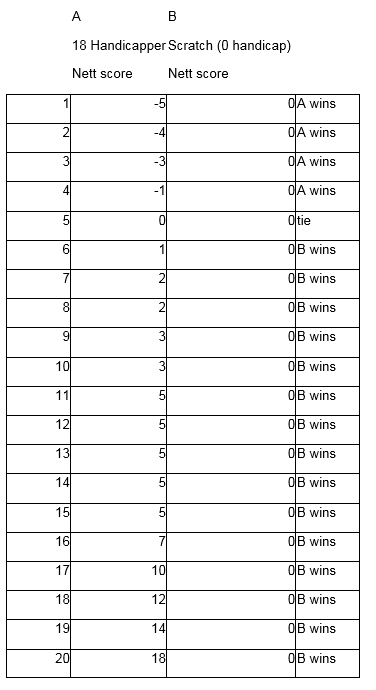
If we put these two golfers head to head then it is pretty clear that the low handicapper is very likely to win. The low handicappers “potential” is the same as his average performance. For the high handicapper he has the “potential” to win the match but since his average score is far higher he is pretty unlikely to do so.

High handicapper A wins only 4 times out of 20 while low handicapper B wins 15 times out of 20.

This is often how a high handicapper perceives golf handicaps. They know they are unfair. They get regularly beaten by low handicappers and have (hopefully) learned not to bet with them on the golf course. It is worth noting though that the lower handicapper will still often moan about how unfair it is to give strokes on some particular hole such as a par 3.

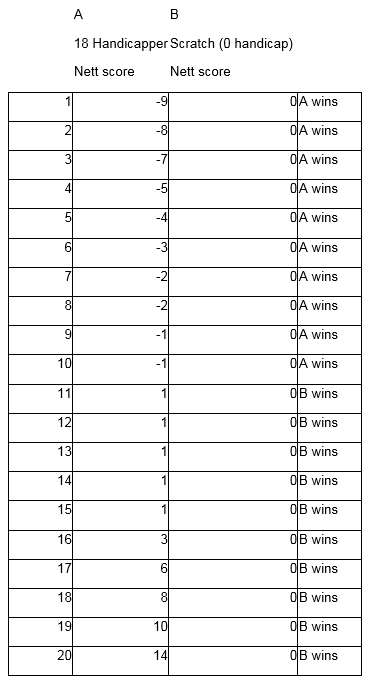
What if we make a different handicap system and do not only include the golfer’s “potential” but all the data on how they actually perform. The 18-handicapper actually averages 22 over par and so if we use that as the handicap instead we get this table of results in which each player wins 10 times.

So is this system fairer? Well not necessarily.

Tournament – high handicapper wins

We just saw that the low handicapper has an advantage in head to head competition. But what if there are lots of players in a tournament. Let’s have 40 golfers, 20 scratch golfers who shoot level and 20 18 handicappers with the range of scores.

If we simply rank all the scores then the top 4 in the tournament will be high handicappers having an unusually great day. But the bottom 15 golfers are also high handicappers having a more typical or even poor day.

The low handicapper has virtually no chance of winning a tournament as the top spots will be taken by a high volatility golfer having a good day. This leads to justifiable frustration from the low handicappers and sometimes the incorrect assumption that the high handicappers must be sandbaggers.

Summary

  1. In head-to-head competition, the low handicapper has a large advantage
  2. In a tournament, a high handicapper is more likely to win

How to combat the problem?

I see problem 2 combatted very frequently. It is common for only a fraction of the handicap to be actually used, such as 2/3 or ¾. I do not have the data to know whether this makes it equally likely for a low and high handicapper to win. But I will be extremely confident that there will be a host of high handicappers with very poor net scores at the end of that event. So even making it “fair” in terms of the overall winner will not result in all participants feeling that way.

I have never seen problem 1 addressed. In practice if anything I tend to see the lower handicapper try to argue for a reduction in strokes given!

A theoretical solution

A theoretical solution would be to recognise that a single number cannot cover both of

  1. Difference in average score
  2. Difference in volatility of score

A revised system could involve a measure of both.

I do not think this is a sensible idea. It would be complex and given the poor quality of the underlying data (self-reported ad hoc scoring) it would be hard to rely on it.

My solution

Head-to-head handicap gold tends to be social and there are more fun ways to decide a handicap. For a regular partner, the winner has to give an additional stroke the next time you play. I doubt you will convince them to give you more strokes any other way.

Handicap golf tournaments perhaps should not be taken too seriously. The system does a decent job and will make the contest close enough and the result uncertain enough to be fun. With the common correction in tournaments everyone has a chance (unless there are real sandbaggers of course) but high handicappers have to accept they have a good chance of a terrible score.

But maybe that is just because I have been playing this tournament for 15 years without winning anything….

Next steps for golf

The global handicap system is being revised.

http://www.randa.org/News/2017/04/World-Handicap-System-to-be-developed-for-golf

I will be interested to see how they deal with the issues.

Desire – Why use a stop-loss?

Once you realise how central desire is to processing information and making decisions, you can appreciate how important it is to be able to deal with it. Just being aware of your desires as we discussed in the previous article sometimes is not enough. The process of investment has a direct impact on your emotions and desires – “Fear and Greed” are well known but that does not make them easy to deal with.

If you are not careful, this will be your process

  • Belief leads to investment
  • The investment leads to the desire it will succeed
  • Desire leads to reinforced belief in the trade
  • The belief leads to confirmation bias
  • The confirmation bias leads to even stronger belief.

By this stage, your emotional ties have now blended with your beliefs

  • The risk is that you cannot process new information correctly
  • You do not get out of the trade when you should and lose money


Introducing the stop-loss

The cycle above is often why books on trading make stop-losses a central element. In fact they are ubiquitous in trading culture, as a hedge fund manager investors would often ask where my stop-loss is on a given position. The theory is clear:

“If you have a rigid and clear stop-loss, which you decide before you enter a trade, and then remain disciplined in sticking to it, then you are protecting yourself from your own inability to objectively evaluate the position after you have put it on.”

This is great advice for most investors. Another great piece of advice would be:

“DON’T TRADE – you aren’t any good at it and will lose money”

The books tend not to mention that one.

IS there an alternative?

A problem with a stop-loss is the trade might still be a great trade. In fact, it could be better or worse that when you initially traded. New information will have become available, but by pre-committing to get out of the trade, you are not able to do anything about it.

There are other ways to manage positions aside from stop-losses. I borrowed a helpful way to think about this problem from George Soros – please read “The Alchemy of Finance” – a truly wonderful book with some very important ideas. One of Soros’ key ideas is the application of Popper’s scientific method to investing. The application of hypothesis testing.

  • Key is not to start with a “belief” that the trade will work, in fact the trade is a test of the hypothesis that the trade will do well.
  • Analysis is therefore considering what would falsify this hypothesis.
  • Hypotheses are falsified all the time and it is nothing to get very excited about.

Therefore, desire is not engaged or at least minimised.

  • This willing suspension of belief is critical to being able to remain objective later.

What can falsify a hypothesis. For example

  • Fundamental news invalidating the underlying idea
  • Price action that tells me what I thought matters in this market, is not what really matters
  • Price action that tells me there is something going on I do not understand.

In practice, this can look very similar to a stop-loss, but It leaves the door open to more discretion and flexibility. For example:

  • Fundamentals have worsened while the price action is fine
    EXIT i.e. do not wait for the stop-loss
  • Fundamentals have improved while price action is poor
    Do not automatically exit as some of the most profitable opportunities from these times of material mispricing. Do more investigation.
    Possibly INCREASE the position size rather than cut it

Conclusion

Working with Soros, I observed that this process allows him to be enormously flexible. He does not seem to fall into the standard pitfall of emotional attachment to his trades. Instead fluidly cutting, increasing or reversing them when he changes his mind. This level of control and discipline sets him apart from the vast majority of traders I have seen.