Games 6 Why do people gamble?

In my previous post, I discussed how the common use of the word “gambling” mixes up volatility with randomness, and frequently leads to incorrect assumptions about skill.

Another perspective on gambling is examine people’s motivation.

Why do they do it?

There are four main motivations I can think of why people gamble

  1. For the excitement, the drama of winning and losing
  2. To add some interest to an activity
  3. To deliberately add volatility to an outcome
  4. To make money consistently


Volatility and expected value

Here is a framework with two dimensions “Expected Value” and “Volatility”.
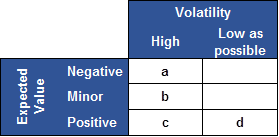
Positive expected value is when you expect on average to make a profit
Negative expected value might be called “against the odds”.

High volatility means that the short-term outcome is highly uncertain
Low volatility means the outcomes are far more tightly distributed.

a. Excitement e.g. playing in a casino

This is the activity that most often comes to mind when we think of gambling: playing roulette in the casino, betting on horse racing. The desire to induce a feeling of vertigo is the primary purpose. https://www.youtube.com/watch?v=TAaSJcIIruI

A key element to this form of gambling is that it has a negative expected value i.e. you lose on average. It is well known that casinos design their games to produce exactly this i.e. the house advantage. The player gets the excitement coming from high volatility; they will lose on average but they might win big tonight!

These games tend to be low skill. There may be a skill in minimising losses but this tends to reduce the volatility or “fun” element. For example, playing Blackjack with Basic Strategy, not difficult to learn, but extremely boring to play as every decision is pre-determined.

This motivation is very common but although I understand it, I do not really enjoy it myself. A low skill game, in which I expect to lose on average, sounds dreadful.

b. Adding interest e.g. betting on a football match you are watching

This is the form of gambling that I think of when I am engaged in an activity, and people say to me they want to “make it interesting”. We might be watching a football match, or playing golf together. There is an underlying activity but it can make it more fun if a monetary aspect is added.

Some people really like this and I think it’s because they really enjoy the gambling aspect i.e. they get to combine an activity they enjoy with gambling which they also enjoy (much like a. above). It could also be that they find the underlying activity a bit dull and want to add something to it to make it worthwhile. They want to experience the feeling of vertigo and having some “skin in the game” will induce or magnify that feeling.

But perhaps the important idea is that it means spectators have a reason to personally care. They are not just watching other people play a game, they have something that means that the outcome directly affects them.

c. Add volatility

This is an interesting category to me. This is where it is important to add volatility to a result and the impact on the immediate expected value is not so important.
Some example may help to clarify what I mean:

i) You owe a loan shark £10k and if you do not pay up in full tomorrow you will be killed. You only have £5k. A good plan is to walk into a casino and put £5k on black (or red). The fact that the bet itself is slightly negative expected value is irrelevant in the broader context.

ii) You are playing chess and are doing badly, perhaps simply down a pawn or two. If you carry on as you are playing sensible moves you will very likely lose. A good strategy here may be to embrace complexity; adding complexity to the board increases the chance of a mistake from either side and may outweigh the initial advantage. Conversely if you are winning, then the simplest route to victory is best i.e. a clear technical win rather than a beautiful attack.

iii) It is the end of a movie and to defeat the monster/get the guy (or girl) /win the game etc the hero acts in a way which is highly likely to fail, but if it succeeds will end in triumph.

What is interesting about this form of “gambling” is that it is highly rational, but only applies in specific situations. If these situations were to repeat, then the expected value and volatility would be highly damaging. Unless of course you are in a Fast and Furious sequel.

d. Make consistent profits

Professional poker players or expert traders/investors fall into this category. They expect to win on average, but accept in the short term they might not. They would prefer to minimise volatility, as they are not engaging in the activity for the excitement and drama, but to make a profit. The volatility is just a price to pay for the longer-term profits.

An aspect of this that is really interesting to appreciate is the extent to which a person who is primarily motivated by winning is usually trying to minimise the feelings of excitement and vertigo. Top sports people train themselves with exercises such as breathing techniques and mental training to disengage their emotional brain as it generally leads to worse performance. Just think about golfers under stress missing short putts or footballers missing penalties in a shootout. It is the same for poker players. The amateur loves the drama but the professional is doing a job.

It is debatable whether this category of wanting to make consistent profits should be even classified as gambling.
Different people have given me clear and differing views. My view is that calling it gambling is very misleading.

This category is exactly the OPPOSITE to the first one in the grid.

  • A pure gambler plays games with NEGATIVE expected value because he WANTS volatility and wants to MAXIMISE the feeling of vertigo
  • A professional plays games with POSITIVE expected value, DISLIKES volatility and wants to MINIMISE the feeling of vertigo.

Matching motivation to the activity

All four motivations make sense. But the motivation should true up to the activity. If you are not being honest about this, it will end badly for you.

a. Excitement
You should look for a game in which you minimise your negative expected value. Then you will be able to play for longer. The dangers of gambling addiction are a massive negative impact on your life.

b. Adding interest

If you like doing it, it seems easy to self-manage. The mistake would be to pretend this is your motivation but, if you are honest, it’s more the excitement of a. This could be a gambling problem in disguise and you need to ensure you do not gamble more than you can afford.

c. Adding volatility

It is a useful skill to recognise how and when you should add volatility to what you are doing. Sometimes in a limited sense it looks risky but when you see the bigger picture it is a very logical approach.

d. Making a profit
People who enjoy playing games of skill and are emotionally able to handle short-term volatility, will enjoy and may excel at.

It is possible that with this motivation you could be seen playing high stakes poker against better players. Your motivation however must be to learn, improve and develop your skill level so that your long-term expected value becomes positive. Other motivations such as you think you are going to win, are likely to be become expensive losses to you.

I described earlier how people commonly think that excitement a. motivates the people in my profession. I also meet plenty of students who love gambling and so want to become a trader. But people like this do not succeed as this is the wrong objective.

For trading and investing, the objective is positive expected value and you want to minimise excitement (volatility). In addition, your desires will likely overwhelm your ability to make profitable decisions.

Conclusion

People engage in activities with uncertain outcomes for very different reasons. If you assume that other people are doing them for the same reasons you are you may be making a big mistake. You need to make sure that your motivations match well with the games you are playing.

Games 5 What is gambling?

I have been writing about games recently: what they are, why we play them and common confusions from not understanding the importance of volatility. A category of game that is worth further investigation are those that falling under gambling.

Definition

Gambling:

  1. Playing games of chance for money / Betting on an uncertain outcome
    “gambling on a toss of the dice”
  2. Take risky action in the hope of a desired result / taking a chance (often) recklessly
    “If you don’t back up your data, that’s gambling”
    “I’m gambling that the new store will be a success.”

I find these two main dictionary definitions to be confusing enough by themselves, but the fact they both have very different meanings can lead to even more confusion.

Is money intrinsic to the game?

If money is not intrinsic to the game, then I would say you are gambling on the game rather than the game itself being gambling e.g. betting on the result of a football match or the number of goals. Football itself is not gambling. If you play golf for money, you are gambling on the game, but golf is not gambling.

In contrast for poker, betting is intrinsic to the game. Attempt to play poker without chips and the game is reduced in skill, becoming like snakes and ladders. Chips are to poker, what goals are to football. Poker tends to be called gambling while golf does not, mainly because the monetary aspect is intrinsic to the game. Here lies an obvious confusion in the definition of the word.

Game of chance

If we go back to the games categorisation, we can observe an important issue.

Volatility?

The first thing to note is that gambling is associated with high volatility. Few people would call playing chess gambling and no-one engages in low skill low volatility games.

Does high volatility imply gambling? It is not that simple. We saw above that it is the addition of money that is critical.

Skill?

Neither definition specifies whether the game or “risky” action involves skill. I think this looseness of definition illuminating. I would say that gambling commonly implies a game of low skill and random outcome. We have seen before how high volatility often leads to the incorrect conclusion that the game is random and low skill (Game 3) We now see a similar issue with games described as “gambling”.

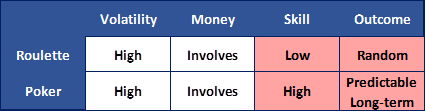
Let’s compare two games:

Both games are referred to as “gambling” but bear crucial differences. Poker has high volatility, but I would not call it a “game of chance” so does not even fit the original definition. However, poker is commonly described as gambling or a gambling game.

Risky vs reckless

In the above definition, both risk and reckless appear and, in common usage, can be used similarly.
However, they are very different concepts.

Let’s take a golfing example. You were the last to play on the last day of the Masters, now standing on the 15th fairway, 192 yards from the flag. Your playing partner is 2 shots ahead of you. You go for the pin.[1]

Risky? Sure
He had not managed an eagle in his previous 450 holes at Augusta

Reckless? Not at all
He needed that eagle to make the payoff which he subsequently won for his first major.

Conclusion

The problem in the definition of gambling is that it does not differentiate between an act of random chance and something which involves a great deal of skill i.e. a non-deterministic outcome with a monetary consequence.

Again we see that this uncertainly in the outcome is misinterpreted is random (logic error) and therefore there is limited skill involved (logic error) and that risk is in fact often reckless (logic error). These confusions are similar to what we have seen in games generally, but still makes them hard to spot.


[1] http://www.golf.com/tour-news/2017/04/09/watch-sergio-garcias-eagle-15th-masters

Games 4 Fooled by Volatility

In the last post (Games 3), we looked at how people may be confused by volatility.
You might think that people who look at financial markets would not be so easily confused.

A great example of such a confusion comes from Nassim Taleb’s bestselling book “Fooled by Randomness”. I would possibly suggest the author has been “Fooled by Volatility”!

Here is my summary of the argument of the book, with my comments on it below:

1. Events have some randomness associated to them

TRUE
Hardly rocket science, but an underappreciated point.

2. Humans are poor at understanding randomness, overemphasizing the importance of small amounts of evidence (often outliers)

TRUE
You can find similar argument in many other books (Gladwell), but useful to highlight and he provides decent examples from finance.

3. People trading the market often assign their success to skill whereas they are just lucky

Partly TRUE
This is certainly at least partially true – some rich people are just lucky and are not smarter.
I think there is a legitimate debate on the degree to which the overall statement is true

4. All trading success is down to luck
Therefore success is evidence of luck


FALSE
This is a logic error. By appealing to the emotions and prejudices of the reader, some may not spot it. The book leaves the impression that all successful traders are just lucky.

Confused by volatility

The source of the error seems to be a conceptual confusion between volatility and randomness. The author observes that outcomes have volatility but names it randomness, since it is “random” this implies there must be no skill. This is exactly the mistake I described in the last post.

It is a shame because some of the underlying arguments (see above) are interesting and true. The fact that outcomes are only partially determined by merit and that people incorrectly over-attribute success to ability is often overlooked.

For a rather extreme example, apparently even Trump’s son-in-law Kushner believes he owes his position purely to merit despite inheriting a huge fortune, reportedly having his place at Harvard bought for him[1] and then marrying the daughter of a billionaire who becomes President.

The rest of the book

For completeness, some notes on the rest of the book:

5. Traders make money by selling tail risks. They all blow up in the end


FALSE
The assumption that this is the only form of trading that exists is ludicrous.
Again, appealing to the prejudices of a certain kind of reader, it implies successful traders aren’t just lucky, they are dangerous.

6. Traders who consistently buying tail risks are the only ones that understand probability, but may appear that they have low skill given their average performance.


FALSE
Here the suggestion is that consistently poor investment results are an indication of integrity and intelligence, which is again ridiculous. Another emotional argument to make people feel better about not being able to replicate the success of others.
See my thoughts on the link between desire and belief here (Desire – The Fatal Flaw).

7. Everyone else who makes money is just lucky, but Taleb can make money by being skillful

!!!!
Here the suggestion is Taleb is a unique genius

Summary:

It is a real pity that the arguments in this book are taken to an illogical extreme, but perhaps this is key to explain the popularity of the book. The points made in the first half of the book are significant and well explained (although not unique to Taleb).

I would have preferred if he had gone on to discuss how to spot the difference between skill and luck; or possibly how to avoid incentivising tail sell behaviour in financial markets.

Instead I read it as some kind of personal therapy about his career angst.
It reminds of a lovely quote – “all autobiography is a form of revenge”.[2]


[1] https://www.propublica.org/article/the-story-behind-jared-kushners-curious-acceptance-into-harvard

[2] As an aside Nocturnal Animals is a great movie on this theme.

Games 3 Volatility and Randomness – common confusions

We have seen from the two previous posts (Games 1, Games 2) that games can be categorised as high/low volatility and high/low skill. We have also seen that higher volatility games are generally more fun to play and certainly make better social games and spectator sports.

Volatility can easily lead to confusion about what sort of distribution of outcome we are looking at. Let’s look at a few examples of this:

High volatility makes relative skill between players hard to see

With any game of high volatility, it can be hard to tell what the skill mismatch between players is.

Take the two charts below. Both games of high skill with players of the same skill differential. In the lower volatility version, the skill differential is obvious, but in the high volatility much less so. In reality, a better chess player will win a high proportion of games, even if the skill advantage is slight. Whereas with poker, we would see a lot more short-term variation in the winning player.

This can have consequences. At a poker table, some people will often play with a very aggressive style, ensuring high volatility in the outcomes of their games. After the game, they will complain about poor luck in not hitting their intended flush on the river, or being regularly outdrawn by another player. They may consider themselves skilful or perhaps, that poker is a gambling game where luck is the driver, without realising they are playing against the odds. They will consistently lose. This is one way that better poker players consistently take money off weaker players, where their own volatility of results blinds them to their lack of skill, so they continue to play.

Volatility acts to disguise any underlying skill differential. This is extremely helpful for the enjoyment of social games but can lead to important mistakes in other areas of life.

High volatility can be mistaken for randomness

If you only had the results of the first 10 games of a highly volatile game, it would be easy to decide that the outcomes are random with no discernible difference in skill. It is quite easy to see why these concepts get confused. Unless you have a lot of data and are paying close attention, it can be hard to spot the difference between a random outcome and an outcome where the volatility is high relative to the skill element. Repeatedly playing a game is often not possible either.

This mistake gets frequently made in economics and economic forecasting. Economies are volatile and this makes precise forecasting generally impossible. This often leads to logic flaw we can saying nothing useful about the future and that experts should be ignored.

A recent example of this is Brexit. Any forecast of growth and living standards over the next decade has a huge error band with or without Brexit. In other words, we are looking at something with inherently high volatility. Adding a large economic shock like Brexit is likely to add even more uncertainty/volatility to any forecast.

It is then commonly argued, in fact often assumed, that since predicting what will happen after Brexit is so difficult given the volatility, it means that economists have nothing useful to say. If “anything” can happen, we should think of the impact as simply random. This is a huge mistake.

In a previous post, “Is Climate Science True” (https://appliedmacro.com/2017/05/17/is-climate-science-true/) I introduced the concept of conditional vs. unconditional forecasts.

To take an analogy, I am thinking of running the London marathon next year.
Please estimate how long it will take me to run it i) in running kit ii) wearing a gorilla costume.
I would strongly expect that your confidence in both of your answers is very low.
However, I bet you are very confident that ii) will take longer than i).

The addition of a gorilla suit adds volatility to the outcome. It does not mean that adding a gorilla suit has negligible impact and the effect is random.

Brexit adds volatility to the outlook for the UK economy. This does not mean the effect is random. It is clearly and strongly negative.

Similarly, average temperatures are volatile. This does not mean that climate change is untrue or that greenhouse gases are not causing it.

Volatility causes confusion on absolute skill of the game

We have seen that volatility can cause confusion on relative skill level.
It can also cause confusion on the overall skill level of the activity

1, High volatility does not mean low skill

It is a common error to assume that because a game has high volatility it means it has a low skill level. As an observer, you might see a relative novice beat an experienced player and conclude that this game is not very difficult to master (poker).
Or another example of an experienced player not consistently able to succeed (baseball home runs, a world number one player knocked out of Wimbledon early)
The nature of the game means that the volatility remains high (it is often designed that way) but the skill level may still be extremely high and difficult to master.

2, Low volatility with evenly matched players does not mean low skill
Think of a game where you only watch match-ups between players of very equal abilities. If you do not share the high levels of skill, then it is easy to think that the outcome is random and the participants’ skill level are not that high.

An example of this is in car racing. I see in Nascar that people drive flat out round and around in circles – not that hard. Even Formula 1 does not look too tricky. I know how to drive and what they are doing looks like my experience of driving. I didn’t really understand the level of skill involved until I went on a track day and witnessed how far even the best amateurs were from professional times, and how much further a decent amateur was from me.


Conclusion

Appreciating how volatility will mask the underlying features of a game is important, to the outsider it is easy to assume that an uncertain outcome implies randomness or low skill.

This is flawed logic.