Trussonomics

I am confused by the calm coverage of the recent radical shift in economic policy – described by the BBC as “bid to boost growth”.  This type of reporting does not make clear whether we are talking short-term growth or long-term potential, and how these policies impact each of them in very different ways.  From conversations with friends, much of the analysis does not investigate this and ultimately reveal just how dangerous and radical this new set of policies is. 


Potential Output – what is it?

Truss has justified her policy changes economically citing improvements in the UK’s long-term growth potential i.e. increasing potential output

Potential output is the starting point for thinking about how much the country can produce ie it is the maximum sustainable level of output. 

If we are below, then this is called a negative output gap and we see things like unemployment rates being high and inflation likely falling. 

The OBR does a great job on this and their website is very clear

Potential Output – how can we improve it?

Everyone wants to improve potential output and there is a clear left vs right divide on how best to achieve it.
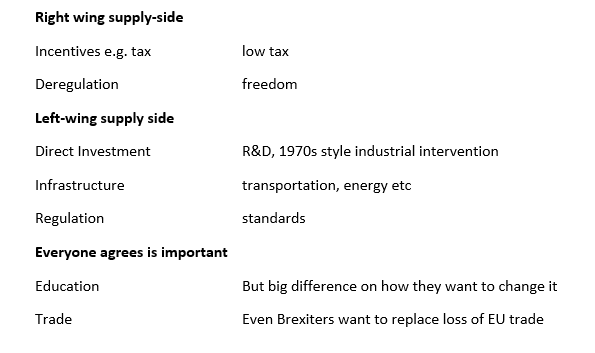
Truss is firmly in the right-wing supply-side movement of “trickle-down” i.e. give tax breaks to rich people and everyone will be better off because somehow this leads to greater potential output.  Reagan was the most prominent exponent of this view but we are still waiting for any evidence that it works.

Potential Output – will it work?

I think best to simply summarise that there is no evidence that cutting taxes has any positive effect on potential output.

OK – so if Trussonomics does not improve potential output, what does it do?

It does a LOT

The most obvious and direct impact is of course on inequality.  She is delivering a massive cash handout to rich people.  The richer you are the more you get. 

The part that is getting less attention is the impact on

  1. Fiscal vs interest rate policy mix
  2. Debt sustainability
  1. Fiscal vs interest rate policy mix

This policy choice has been perhaps at the heart of the political battle of the past decades and is commonly misunderstood.  This is a shame as a simple quadrant model does a good job of providing a framework to compare the options clearly. (Fiscal policy is the mix of tax and spending with high spending/low tax being loose fiscal policy)

Tight fiscal -tight monetary         When you are committed to fighting inflation above other policy goals.  For example, the 1980s or commonly after an economic crisis when trying to rebuild confidence in the currency and debt.  If used inappropriately looking at the 1930s Great Depression.

Tight fiscal – loose monetary     This is the Cameron years.  There is of course a debate over how tight fiscal policy should have been and on how the mix of tax and spending was managed.  But it is a consistent policy mix

Loose fiscal – loose monetary    This was at its maximum during the pandemic i.e. for a short term huge negative shock.  If used long term it just leads to economic catastrophe.

Where are we now?

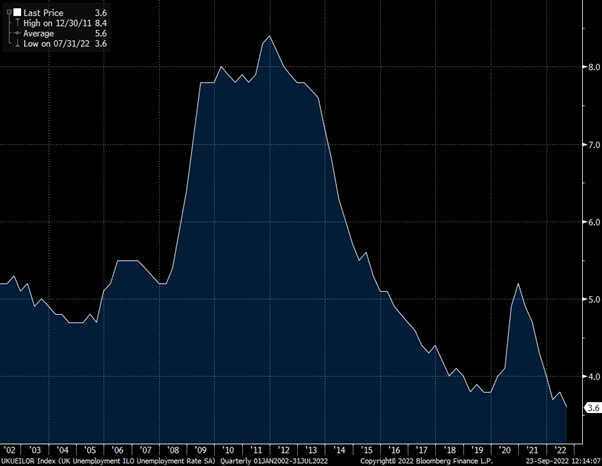
We are currently in the loose/loose box.  Taking the unemployment rate as a simple measure of the output gap, you can see from the chart below we are at record lows.  This is also clear to anyone trying to hire at the moment and all the reports of staff shortages.  Which makes it odd that Truss talks about “boosting growth” as there is no prospect of lower unemployment from here.

UK Unemployment at record lows
The other factor that makes going for growth an odd policy goal is that inflation is high and rising.  This does not have an easy solution and economic pain is unavoidable.  Trying to avoid it, leads to even greater pain later.

UK Inflation at 30-year highs

What happens next?

The Bank of England will be forced to raise interest rates by huge amounts.  At the start of this year the market expected interest rates to stay at around 1% though 2022 and 2023.  Now the market expects rates to be 4% by the end of this year and 5.5% by the end of next year- with rate expectations for next year shifting 3% since the start of August. 

What does this mean for people?

Well rich people have had a large tax cut and will be fine – I know you are all relieved to hear this.

Anyone on a regular income has had a small tax cut but this will be dwarfed by the rise in the mortgage payments coming soon.


What does it mean for the economy?

I predict a very bumpy path and hard landing for the economy but difficult to say when.  The policy mix of vast fiscal expansion at a time of low unemployment and high inflation to be offset by rapid interest rate rises is a chaotic mix.  I think the economy will stay strong and then crash hard. 

  1. Debt sustainability

This is getting some attention but is being dismissed by Truss.  The fact that they did not let the OBR produce a forecast tells us a lot about how they have contempt for this constraint on policy.  An Office of Budget Responsibility is not what the Chancellor wants to hear from!

But the bond market still exists, and long-term government borrowing is getting hammered.  30-year Gilt yields have risen from under 1% at the start of the year to 4% as I write this.

The tax cuts and extra spending increases the budget deficit.  The rise in interest rates increased the cost of servicing the debt, further increasing the budget deficit.  This can become an exponentially explosive mix with the major accelerator being a currency crisis as the value of sterling falls.

Conclusion

The Trussonomics experiment is radical and dangerous.  I expect high inflation, high interest rates and a weak currency leading to economic crisis.  Politically I expect her to start to blame the Bank of England as though the rise in interest rates was not a direct result of her policies.  The Bank of England may be independent of the government, but they are not independent of economic reality.

Truss has spoken of her disdain for “abacus economics” and she does not believe things need to add up.  I think economic reality exists and her magical money tree fantasy will fail. 

The ethics of climate change

The ethics of climate change raises the most difficult questions.
I am not writing an environment blog, but to get a sense of the difficulty of the philosophical issues, here are some of the big questions:

  1. Intergenerational transfers
    The costs are borne by people alive today for the benefit of people who are not yet born. How do we balance the interests of those two groups?
  1. Democratic Mandates
    Is a country run a by a government with a mandate to look after the current population? Or for the long-term future of “the country”?
  1. Historical Emissions
    Should historic carbon emission be allocated to countries?
    Is the nation state the bearer of historic liabilities from the activity of its deceased former inhabitants? Do new immigrants take on this liability?
  1. Developed versus Developing economies
    How do we balance the desire for developing economies to grow into developed ones and the West’s desire to stay wealthy with a decline in carbon usage?
  1. Is Carbon a right or a consumption good?
    Is carbon usage a consumption good like any other i.e. the rich get more of it
    or is it a human right in which every person on earth has an equal right?

It’s interesting how infrequently these issues get discussed in the public debate, which focuses primarily on the technical models or measurement issues. It is also striking that an issue like Climate Change can so accurately be characterised as partisan issue of political left vs right. That Trump wants to withdraw from the Paris Agreement or that Bernie Sanders supports environmental action is not surprising. This predictable difference cannot be explained away by describing your opponents as crazy, it is more likely to come from a deeper difference of view on the underlying ethical issues.Whenever I hear a climate scientist claiming authority and opining that the science indicates a particular policy path, I feel that they have just not understood how difficult this problem is. They generally have no expertise or authority in anything other than a narrow field and like all of us bring our personal ethical values to the debate. When scientists unknowingly embed their ethical views into their scientific views it makes it far easier for their opponents to criticise the science.

Science is important but philosophy matters too.

Is Climate Science True?

If this blog were the BBC, in an effort for impartiality, I would give equal time to 2 ideas:

  1. Climate change is completely true
    Agreed by all reputable scientists and means drastic action needs to be taken immediately
  2. Climate change is a hoax
    Devised by the Chinese to limit the US economy and we need do nothing

However, I’m not bound by any such desire for manufactured impartiality so would like to ignore climate denial theories. I want effective action to be taken and I’m interested in why the first argument is failing to find broad enough support against those who want to dismantle the Paris Agreement.

The Science

I think I can reasonably simplify the scientific arguments to this:

  1. There is an empirical relationship between carbon and temperature
  2. There is a causal theory relating the two, the greenhouse effect
  3. There is no better theory, in fact no other credible theory

The criticisms for each item can be summarised like this:

  1. Poor and incomplete data
  2. The underlying system is dynamic and complex
  3. The models are not very precise with large amounts of uncertainty.

The responses I have seen to these criticism from climate change scientists are:

  1. We are collecting more data all the time. We are cleaning up the old data sets.
  2. We are building more complex models which incorporate more variables
  3. We are working to improve our accuracy with better models to reduce the level of uncertainty.

Coming from a macroeconomics background, the criticisms wouldn’t bother me much. We face them all the time. The responses from the climate change scientists do bother me however. If this reflects their research programmes, I fear they are heading in the wrong direction, sharing many of the methodological problems we see in macro and likely making the same mistakes.

My view

My preferred responses to the criticism would be

  1. Yes, the data is poor and incomplete. Not much we can do about that. We will not clean up data to pretend it is better than it is.
  2. Yes, it is dynamic and complex. Attempting to making models more complex would mean data-mining the limited data sets to produce models which are pretty but have no validity. Simple models of complex systems often work much better. Read the Borges short story (https://appliedmacro.com/2017/05/11/models/) for an elegant refutation of the idea that seeking perfection in models leads to good outcomes.
  3. Accurate forecasts are not possible because we do not have ‘out of sample’ data and associated feedback. There is little new data to use so we cannot properly test hypotheses in the way we can with weather forecasting.

The good news is that we do not need accurate forecasts because:

  1. If our model provides an unbiased best estimate and uncertainty is two-sided, then the level of uncertainly around it does not affect the policy response. Essentially the policy response will be versus the expected increase in temperature.
  1. We are providing conditional, not unconditional forecasts.
    To take an analogy, I am thinking of running the London marathon next year. Please estimate how long it will take me to run it i) in running kit ii) wearing a gorilla costume. I would strongly expect that your confidence in both of your answers is very low. However, I bet you are very confident that ii) will take longer than i).

Financial markets can be a very good training ground for learning about practical model building and their methodical dangers. Most of us have been seduced by beautiful models with great back tests with desirable correlations and high Sharpe ratios. But then trying to use them to make money, we find they had no predictive qualities at all. After enough painful experiences, we learn to be highly suspicious of any model that fits the data too well – it is the obvious symptom of data-mining. The models that work in practice are the ones that are intuitive, simple and accept that the world is a messy complicated place.

What climate change scientists and macro-economists can actually do have a lot of similarities. We do not know what the temperature will be on October 23rd 2087 but we have a good guess it will be higher if there is more carbon in the atmosphere.

Models

Since I discussed models in my last post, I could not resist saying something quickly about what they are for. This is a very important topic and one I will frequently return to.

But for now, I will just give you a brilliant short story from the most inventive and thought-provoking author I know.

Jorge Luis Borges. “On Exactitude in Science” or “Del rigor en la ciencia”.